
There are weeks in September where the calendar of a vacation rental property in Orlando can sit empty for five days straight. For an owner seeing that for the first time, the immediate reaction is to lower the price. For an experienced one, the reaction is to review the seven available levers before touching the price.
Lowering the price is the last lever, not the first. And when it’s lowered without strategy, it captures the most price-sensitive guest segment, which is generally the one that leaves the worst reviews, treats the property worse, and doesn’t come back.
These are the strategies that actually work when bookings fall.
Strategy 1: audit the listing before touching the price
Before assuming the problem is the price, check whether the listing is doing its job. A poorly optimized listing can have zero bookings at a competitive price, while a well-built one fills the calendar at a rate 20% higher.
Listing audit checklist:
Photos: Does the main photo show the pool or the exterior in good light? Properties with a pool photo as the main image get between 15% and 25% more clicks than those showing a room or the living room. Are the photos taken with natural light during the day? Are there at least 20 quality photos?
Title: Does it include the keywords guests search for? For Orlando: “private pool,” “near Disney,” number of bedrooms, community type. “5BR Pool Home Near Disney | ChampionsGate” converts better than “Beautiful Orlando home with pool.”
Description: Do the first 150 characters (what’s visible without clicking) mention the property’s main benefit? Guests decide whether to open the listing based on the photo and those first lines.
Reviews: If you have fewer than 10 reviews or your rating has dropped below 4.7, that directly impacts Airbnb’s algorithm. A property with a 4.6 average appears significantly less than one with 4.8 in searches filtered by rating.
Strategy 2: adjust the minimum nights
The minimum nights setting is one of the configurations with the greatest impact on occupancy and one of the most ignored.
If you have a 3-night minimum, you don’t appear in searches for 1 or 2-night stays. In low season, when short weekend trips are more common, that can be the difference between 60% and 45% occupancy.
The optimal strategy isn’t a fixed minimum but a dynamic one: 3–4 nights in high season (when there’s enough demand to fill with longer stays), 2 nights in mid-season, and 1 night for the last 3–5 days available before a nearby date.
Tools like PriceLabs allow configuring these rules automatically. Without a tool, it can be adjusted manually month by month, which takes 10 minutes but can increase occupancy by 5–10 percentage points in low season.
Strategy 3: activate strategic discounts, not generic ones
There are three types of discounts that generate bookings without damaging the property’s perceived value:
Last-minute discount: For days without a booking that are less than 72 hours away. A 15%–20% discount for last-minute bookings is accepted by guests because it has a clear logic (immediate availability) and doesn’t devalue the regular rate.
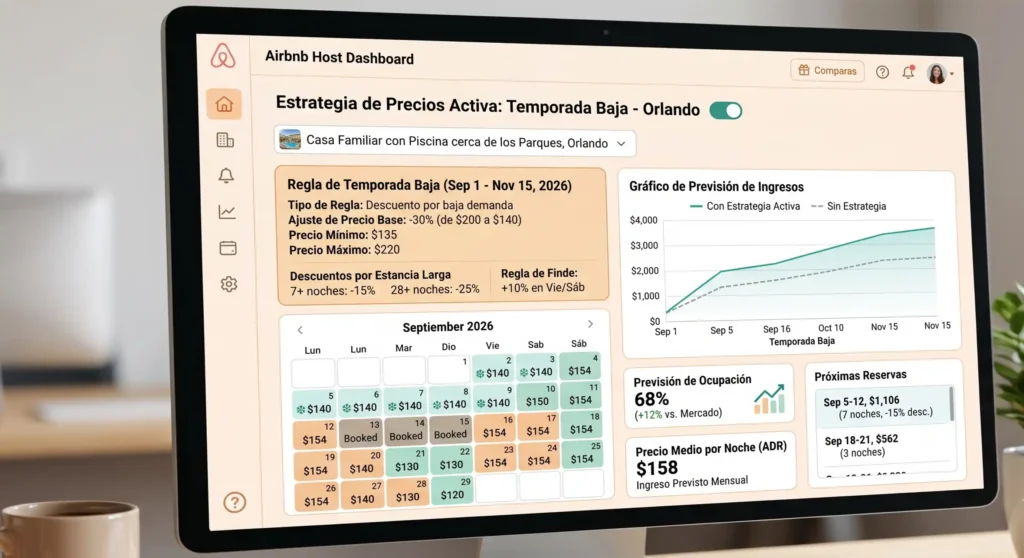
Long-stay discount: For stays of 7 nights or more, a 10%–15% discount is standard in the Orlando market. For stays of 28 nights or more (which fall into the mid-term rental category), discounts can be 25%–35% because variable costs per night are much lower.
Early bird discount: For bookings made more than 90 days in advance. Particularly useful for securing the following summer during the quiet September-October period. A 10% discount for bookings with 3+ months’ notice can fill your summer calendar during peak low season.
What to avoid is lowering the base rate for the entire season in a general way. That repositions the property in a lower price segment and is difficult to reverse.
Strategy 4: diversify channels beyond Airbnb
Airbnb has the largest traffic volume for vacation rental properties in Orlando, but it isn’t the only relevant channel.
VRBO (part of Expedia Group): Has a different user profile: families who plan further in advance, longer stays, and lower price sensitivity. For 4+ bedroom properties, VRBO can generate between 15% and 30% of additional bookings.
Booking.com: Greater presence of international travelers, especially from Europe and Latin America. The registration process is more complex than Airbnb (requires contract and invoicing) but worth it for properties wanting to capture that segment.
Direct bookings: If you have returning guests or referrals, you have the basis for a direct channel. A simple website with a booking system (Lodgify or Hostaway make this easy) allows receiving bookings without a platform commission. Some Orlando property owners with 2–3 years of operation generate 10–20% of their bookings through a direct channel.
Managing multiple channels without a channel manager is risky due to double bookings. Hostaway, Guesty, and Lodgify synchronize calendars in real time between all channels for between $50 and $150/month, which pays for itself by avoiding even one double booking per year.
Strategy 5: position for specific Orlando events
Orlando doesn’t run on Disney alone. There are events throughout the year that generate concentrated demand, and most property owners don’t actively leverage them.
High-demand events in low season:
- Halloween Horror Nights (Universal): September to November. Draws adults specifically for this event. Mentioning proximity to Universal and the event in the listing title and description during those months can capture those searches.
- Epcot Food & Wine Festival: October to November. Adult segment, higher purchasing power. Properties near Epcot have an advantage, but any property can position itself by mentioning the festival.
- Disney Marathon Weekend (January): Tens of thousands of runners and their families. The first two weeks of January are among the most active of the year for this segment.
- Grad Bash (Universal, April): High school students and their families. Specific demand that fills hotels and looks for group houses.
The concrete tactic is to update the listing title and description to mention these events in relevant months. It’s a 10-minute change that can increase visibility in event-related searches.
Strategy 6: target alternative demand segments
Families with school-age children represent 60% of Orlando’s vacation market and are also the first to disappear in low season. The segments that remain active during those months are different and require a different approach.
Remote workers (workcation): Stays of 2–4 weeks. They look for fast WiFi (minimum 200 Mbps, verifiable), a workspace, good natural lighting, and a comfortable space for video calls. A property that actively mentions “fast WiFi, dedicated workspace, remote-work friendly” in the listing can capture this segment.
Retirees. Complete date flexibility, preference for avoiding peak season, willing to pay well for comfort. A well-equipped adult property (without children’s décor, with a quality mattress, comfortable outdoor area) can actively position itself for this segment.
Adult groups. Birthdays, friend reunions, bachelor parties. Photos of the outdoor entertainment area (pool lit at night, barbecue space, poker or ping pong table) attract this segment more than bedroom photos.
Latin American travelers in off-season. Countries like Colombia and Peru have school vacations in June-July and December-January, but also during specific weeks in October. Having the listing in Spanish can capture searches from that segment.
Strategy 7: review the dynamic pricing strategy every quarter
Dynamic pricing isn’t a one-time configuration that’s forgotten. The market changes, competition changes, and the tools need periodic adjustments to reflect those changes.
The three variables worth reviewing every quarter:
Base price: Is it still competitive against similar properties in the same community? If you set a base price of $195/night 18 months ago and the market has risen, you can likely move to $210 without losing occupancy.
Minimum price: The floor you set for the algorithm. If it’s too high, the system can’t drop low enough in low season to be competitive. If it’s too low, you end up accepting stays that don’t cover variable costs.
Event adjustment rules: Are special prices configured for high-demand events (Christmas, Thanksgiving, Disney Marathon)? A standard price during Christmas week is money left on the table.
For owners using property management, this quarterly review should be part of the conversation with the PM. If your Orlando property management company isn’t actively doing this review, it’s a valid question to raise with them.
Frequently asked questions
How much can occupancy recover with these strategies?
It depends on the starting point. A property with a poorly optimized listing can recover 10–15 occupancy percentage points with listing improvements and correct dynamic pricing alone. A well-managed property applying these strategies can recover an additional 5–8 points above its current baseline.
Does dynamic pricing work if the property manager already handles it?
It depends on how actively they manage it. Ask your PM for the historical ADR and monthly occupancy data for your property and compare them with market averages for comparable properties in the same community. If your occupancy is systematically lower than the average for comparable properties, something isn’t working.
When should I lower the base price?
When you’ve had more than 2 weeks of open availability on dates less than 30 days away and there are no bookings. That’s a clear signal the price is out of the market for those dates. A 10%–15% drop on those specific dates is more effective than lowering the overall base price.
Does adding VRBO double the workload?
With a channel manager, not significantly. Managing VRBO messages and bookings is similar to Airbnb. The real additional work is in the initial listing setup and responding to VRBO inquiries, which have a lower volume than Airbnb.
Can negative reviews destroy a property’s occupancy?
A single 3-star review with a well-managed response rarely destroys a listing with a good history. What does strongly impact is dropping below the 4.7-star average, because Airbnb suppresses the ranking of properties below that average in rating-filtered searches.
If you want a review of your Orlando property’s current strategy, or if you’re evaluating buying and want to understand how to optimize operations from day one.