The EB-5 visa is one of the most direct paths that exist to obtaining permanent residency in the United States through investment. It is not the cheapest or the fastest, but for a Latin American investor with available capital and a clear immigration objective, it can be the most solid option available.
The problem is that there is a lot of confusion about how it works, what it actually costs and what role real estate plays in the process. This article clears that up directly.
What the EB-5 visa is and what it offers
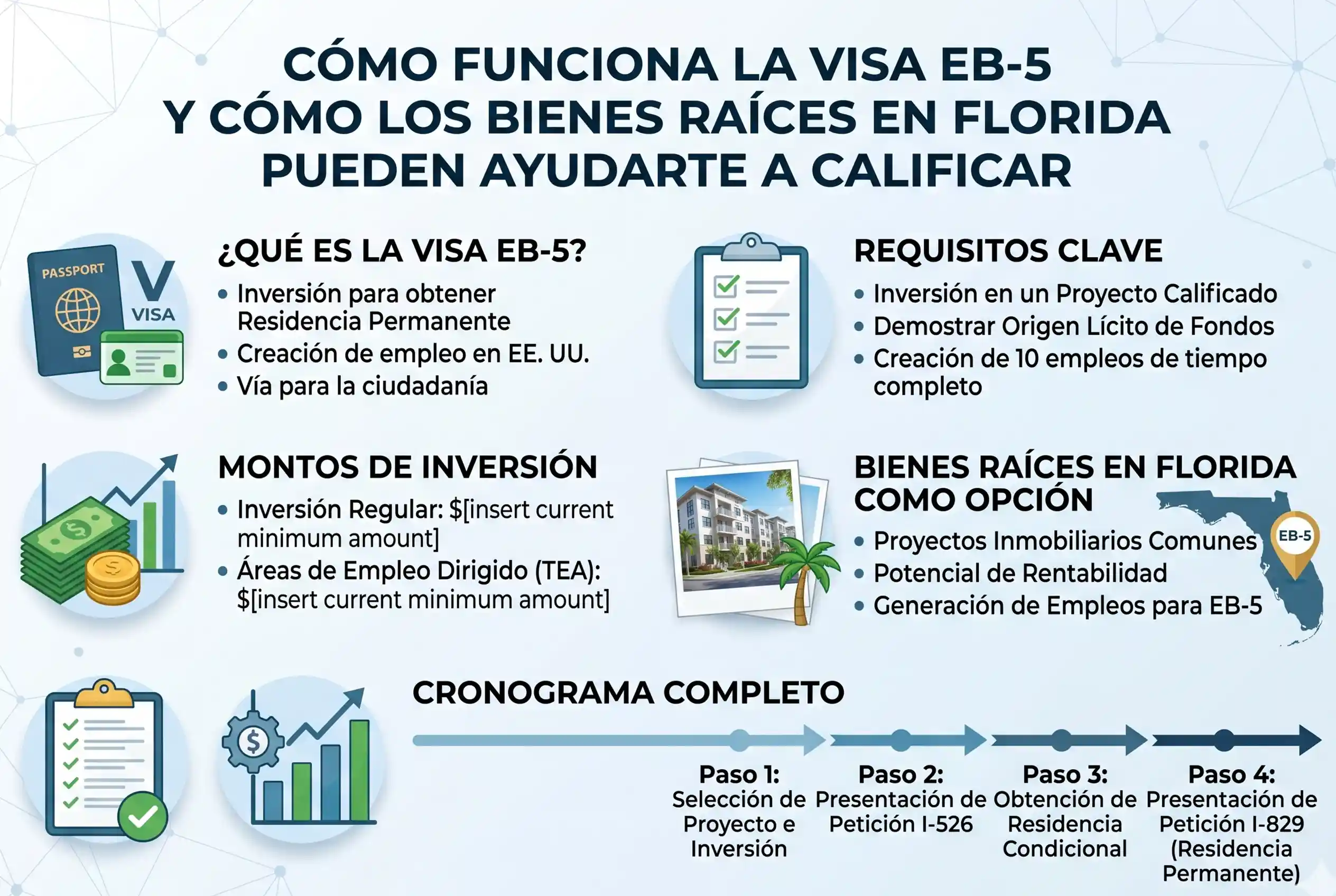
The EB-5 (Employment-Based Fifth Preference) visa is a federal government program that grants permanent residency to foreigners who make a significant investment in the United States and create at least 10 full-time jobs for American workers.
The end result, if the entire process is completed correctly, is a permanent Green Card for the investor and their direct dependents: spouse and unmarried children under 21.
What the EB-5 is not: it is not a work visa, it does not automatically guarantee citizenship and it is not a fast process. Processing times vary depending on the applicant’s country of origin and the category of the project.
Investment requirements in 2026
| Investment type | 2026 minimum amount | Jobs required |
| Targeted Employment Area (TEA) | $800,000 | 10 direct or indirect jobs |
| Rural area | $800,000 | 10 direct or indirect jobs |
| Non-designated area | $1,050,000 | 10 direct jobs |
| Regional Center (fund) | $800,000 | 10 indirect jobs allowed |
Since the EB-5 Reform Act of 2022, the $800,000 minimum applies to both urban and rural areas within designated Targeted Employment Areas. The higher threshold of $1,050,000 applies when the investment is not in a designated TEA.
The job creation requirement is what most complicates the direct connection with real estate. A residential rental property does not generate 10 full-time jobs on its own. That is why most EB-5 investors do not invest directly in a property but through a Regional Center.
Regional Center vs direct investment: what is the difference
Direct investment The investor puts capital into a specific business or project, has active control over management and must demonstrate that the investment created 10 documented direct jobs. It is more complex to execute and harder to document the required jobs.
Regional Center (the most common route) Regional Centers are USCIS-approved entities that pool capital from multiple EB-5 investors to finance larger-scale projects: hotels, mixed-use developments, residential or commercial complexes. Jobs can be indirect, which makes meeting the 10-position requirement easier.
In Florida, there are several active Regional Centers with projects in Miami and Orlando. Some involve large-scale real estate development such as luxury condominiums in Brickell, hotels in the Orlando convention area or mixed-use developments in expansion zones.
If you are evaluating this route, the immigration consulting team at Florida HomeGroup Realty can guide you on active Regional Centers in Florida and how to evaluate the strength of each project.
Can residential real estate qualify for EB-5?
This is the question that generates the most confusion. The short answer is: rarely in a direct way.
A residential investment property rented on Airbnb or with an annual contract does not generate 10 full-time jobs on its own. The property manager, cleaning crew and maintenance typically do not reach that threshold.
However, there are scenarios where residential real estate can be part of an EB-5 structure:
- A property management company with sufficient scale to document 10 direct jobs
- A new construction development where construction work generates documentable employment
- Participation in a Regional Center that invests in large-scale residential projects
The distinction matters because many advisors present the purchase of a vacation property as an “EB-5 investment” when it does not actually qualify under the program’s criteria. That mistake can cost months of process and thousands of dollars in legal fees.
The EB-5 process step by step
Step 1: Project or Regional Center selection Choose where to invest. If through a Regional Center, review the project’s track record, promised returns, legal structure and whether USCIS currently has it approved.
Step 2: Legal and financial due diligence Before transferring funds, hire an immigration attorney with EB-5 experience to review the project documents and investment structure. Typical fees are $15,000 to $25,000 for the full process.
Step 3: Capital transfer The investment amount must be transferred from an account in the investor’s name. The source of funds must be fully documented. The IRS and USCIS verify that the capital comes from legitimate sources.
Step 4: I-526 filing with USCIS This is the initial petition demonstrating that the investment meets the program’s requirements. Processing times vary but currently range from 12 to 36 months depending on country of origin.
Step 5: Immigrant visa or adjustment of status Once the I-526 is approved, the investor can apply for the immigrant visa (from abroad) or adjustment of status (if already in the US). At this stage, the conditional Green Card is issued for 2 years.
Step 6: Removal of conditions (I-829) Two years later, the investor files the I-829 to demonstrate that the investment was maintained and the jobs were created. If approved, the Green Card becomes permanent.
For guidance on the most appropriate legal structure for your case, you can also consult our page on legal advice to protect your real estate investment in Florida.
Comparison table: EB-5 vs other investor visas
| Visa | Minimum investment | Permanent residency | Estimated time | Active employment required |
| EB-5 | $800,000 | Yes (Green Card) | 3 – 7 years | No (via Regional Center) |
| E-2 | No federal minimum* | No | 3 – 6 months | Yes |
| L-1 | N/A | Not directly | Variable | Yes (transferred employee) |
| O-1 | N/A | No | Variable | Yes (extraordinary ability) |
*The E-2 visa has no federal minimum, but consuls evaluate whether the investment is “substantial” for the type of business.
FAQ about the EB-5 visa for Latin Americans
How long does it take to get the Green Card with EB-5?
It depends on the country of origin. For most Latin Americans (Colombia, Mexico, Venezuela, Peru), current timelines are between 3 and 6 years from I-526 filing to permanent Green Card. China and India have much longer waits due to application volume.
Can I recover my EB-5 investment?
It depends on the project. Some Regional Centers structure the investment as a loan to the developer that is repaid after 5 to 7 years. Others structure it as a project stake with no return guarantee. Reading the project prospectus with an attorney is essential before committing capital.
Does my family also get the Green Card?
Yes. The EB-5 visa includes the investor’s spouse and unmarried children under 21. All receive the conditional Green Card and then the permanent one once conditions are lifted.
Can I combine EB-5 with a real estate investment in Florida?
Yes, if the structure allows it. Some investors use EB-5 for the immigration process and purchase additional residential properties in Florida as a separate investment. The two objectives are not mutually exclusive but require separate legal and financial structures.
The EB-5 is a valid path to permanent US residency for those who have the capital and the patience for the process. Presenting it as a simple option would be dishonest. But for someone with a clear immigration objective and the necessary capital, it is one of the most solid programs available.
Talk to our immigration advisor and evaluate whether the EB-5 is the right path for you