
September arrives and bookings drop. October doesn’t pick up much either. November recovers slightly around Thanksgiving, but the two-month gap before December holidays can leave a vacation rental in Orlando with entire weeks unoccupied.
This isn’t a problem exclusive to careless owners. It happens to most. The difference between investors who maintain high occupancy year-round and those who suffer those gaps isn’t luck or a magical location. It’s active management and a few decisions made before low season arrives.
When is low season in Orlando and how long does it last
The Orlando vacation rental market has well-defined peaks and valleys. Knowing them allows planning instead of reacting.
High season: mid-June to mid-August (family summer), December (holidays), Thanksgiving week, Easter week, and March spring break.
Mid season: late March to May, October to mid-November.
Low season: first half of September, first days of January, second half of August.
The most challenging period is September. Families have returned from vacation, children are back in school, and domestic tourism drops significantly. That month, properties that ran at 90% occupancy in July can drop to 40–50%.
| Period | Average occupancy Kissimmee area | Average ADR |
|---|---|---|
| Jun–Aug (summer) | 80–90% | $220–$280 |
| Dec (holidays) | 85–95% | $250–$320 |
| Mar–May | 65–75% | $175–$220 |
| Oct–Nov | 55–65% | $160–$195 |
| Sep | 40–55% | $145–$175 |
| Jan (post-holidays) | 45–55% | $140–$170 |
Strategy 1: real dynamic pricing, not just lowering rates
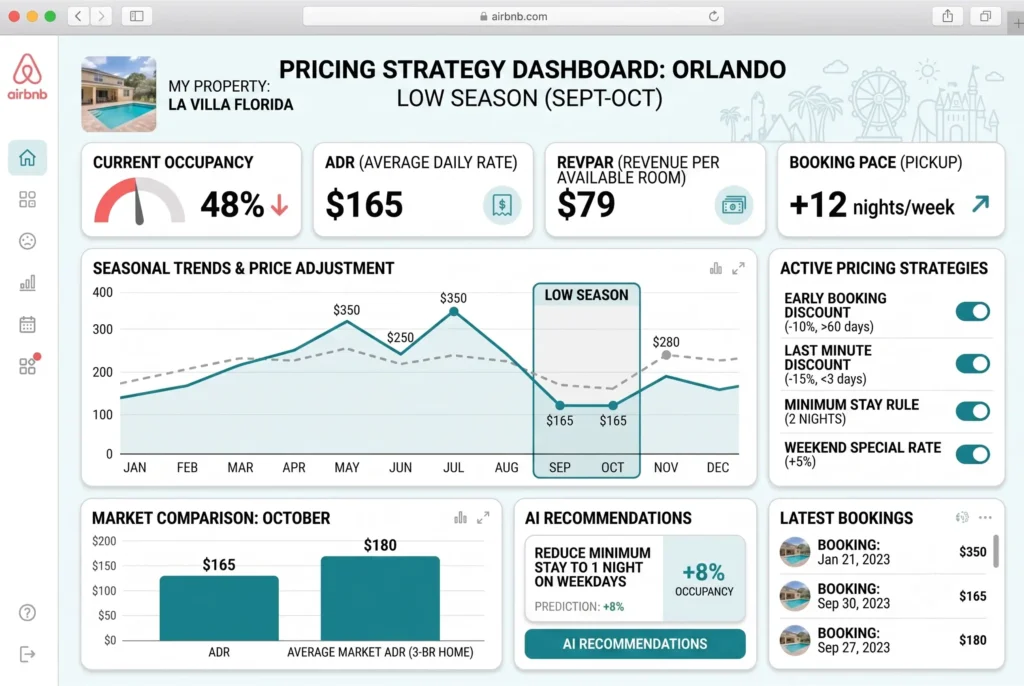
The most common mistake in low season is lowering the price linearly and waiting for bookings to come on their own. Dynamic pricing is more sophisticated than that.
Dynamic pricing tools like PriceLabs, Wheelhouse, or Beyond automatically adjust the nightly rate based on market demand, bookings of comparable properties in your zone, and local events. A well-configured property on PriceLabs can increase annual income between 15% and 25% compared to a property with fixed pricing or monthly manual adjustments.
In low season, the goal isn’t always to maximize the nightly rate but to maximize total monthly income. Sometimes that means dropping the price 20% to secure 5 additional nights. Other times it means holding the price and waiting for long-stay guests who pay less per night but more in total.
Configurations that help in low season:
- Reduce the minimum nights from 3–4 to 2 nights
- Activate automatic discounts for last-minute bookings (last 48–72 hours)
- Offer 10–15% discounts for stays of 7 nights or more
- Open flexible check-in days (not just Saturday or Sunday)
Strategy 2: target demand segments that travel in low season
Families with school-age children are Orlando’s primary market and also the ones who most respect the school calendar. In low season, the segment that keeps traveling is different.
Retirees and older adults. They have complete date flexibility and prefer traveling outside peak season to avoid crowds at the parks. A well-equipped 3-bedroom property for adults (without children’s character décor, with fast WiFi, full kitchen) can actively attract this segment.
Adult groups without children. Birthdays, bachelor/bachelorette parties, friend reunions. They search for large homes with pools and don’t depend on the school calendar. Marketing for this segment requires different photos (adult entertainment spaces, pool area as the hero) and a description oriented toward “group getaway” rather than “family vacation.”
Remote workers. Since the pandemic, there’s a growing segment of travelers who combine work and leisure (workcation). A property with a dedicated desk, ergonomic chair, high-speed WiFi (200 Mbps minimum), and good lighting can actively position itself for this segment with stays of 2 to 4 weeks.
Latin American international travelers. September and October are high season in several Latin American countries. Colombians, Venezuelans, and Peruvians with children in private schools that have vacations in those months are a specific segment that travels to Orlando in those dates. Having the listing in Spanish or with a bilingual description helps capture those searches.
Strategy 3: diversify distribution channels
Airbnb is the primary channel for most Orlando property owners. But depending on a single channel in low season limits visibility.
VRBO (part of Expedia Group): Has a different user profile from Airbnb, with a higher proportion of families who book further in advance and take longer stays. For properties with 5+ bedrooms, VRBO can be more effective than Airbnb in certain months.
Booking.com: Has greater presence of international travelers, especially from Europe and Latin America. The registration process is more complex than Airbnb (requires contract and invoicing) but worth it for properties wanting to capture that segment.
Google Vacation Rentals: Properties listed on compatible platforms appear directly in Google search results. It’s a visibility channel many owners ignore.
Direct channel: A simple website with a booking system (Lodgify or Hostaway make this easy) allows receiving bookings without platform commission. Especially useful for returning guests or referrals. Some Orlando property owners generate 15–20% of their bookings through a direct channel after the first year.
A channel manager like Hostaway, Guesty, or Lodgify synchronizes calendars and pricing across all channels from one place, avoiding double bookings.
Strategy 4: events and demand generators in Orlando
Orlando doesn’t live on Disney alone. There are events throughout the year that generate specific demand, and most property owners don’t actively leverage them.
Halloween Horror Nights (Universal). Runs from late September through early November, exactly during low season. It generates real demand from adults traveling specifically for this event. Mentioning proximity to Universal and the event in the listing during those months can capture those searches.
Epcot International Food & Wine Festival. October to November. Attracts an adult segment with higher purchasing power. A property near Epcot can actively position itself for this period.
Events at Orange County Convention Center. The OCCC is one of the largest convention centers in the U.S. and has events year-round, including September and October. Properties within 20 minutes of the Convention Center can capture business travelers and conference attendees.
Disney Marathon (January). The Walt Disney World Marathon Weekend in January attracts tens of thousands of runners and their families. It’s one of the biggest low season events and generates real occupancy in the first weeks of January.
Strategy 5: optimize the listing for low season searches
Airbnb’s algorithm favors listings with high conversion rates (clicks that convert into bookings) and fast response to inquiries. In low season, competition between similar properties increases because there’s more availability. Optimizing the listing helps stand out.
Seasonal photos: The listing photos should show the property in conditions similar to what the guest will find. In low season, updating the main photos to show the pool lit at night, cozy interior spaces, and entertainment amenities can improve conversion.
Segment-oriented description: If in low season you’re targeting adults or remote workers, the listing description should reflect that. Mention the desk, WiFi speed, pool privacy, and surrounding tranquility.
Fast response: In low season, many travelers compare multiple properties. Responding within an hour to inquiries and booking requests significantly increases the probability of closing.
The work of listing optimization and active channel management is exactly what differentiates a professional property management company in Orlando from simply having the property listed on Airbnb.
Strategy 6: the mid-term rental option
For owners who can’t achieve sufficient occupancy in low season with vacation rental, mid-term rental is an alternative worth considering.
Mid-term rental (MTR) means stays of 30 to 90 days. It isn’t subject to the municipal short-term rental restrictions (which in Florida apply only to stays under 30 days), and it has a stable market of travelers: healthcare workers on temporary assignments, families in transition buying a home, professionals on short-term projects.
Income per night on MTR is lower than vacation rental (between $80 and $130/night in the Orlando area), but vacancy and operating costs are also lower. Some owners keep the property in vacation rental mode from May to August and in MTR mode from September to February, optimizing total annual income.
Frequently asked questions
How much can occupancy drop in low season in Orlando?
In the worst month (first half of September), properties without active management can drop to 30–40% occupancy. With dynamic pricing and segmentation strategies, it’s possible to maintain between 50% and 65% in that same period.
Is it worth hiring a property manager just for low season?
Most property management contracts are annual. What is worth doing is evaluating whether your current property manager has active low season strategies or simply lowers the price and waits. Ask them specifically what they do in September and January.
Can dynamic pricing drop the rate too low and damage the property’s perception?
It’s a real risk if not configured correctly. PriceLabs and Wheelhouse allow setting a minimum nightly price below which the system won’t go. Defining that floor correctly is important.
Do last-minute discounts hurt the property’s reputation on Airbnb?
Not directly. Airbnb doesn’t penalize last-minute discounts. What can affect ranking is accepting last-minute bookings from guests with no history or low ratings, which increases the risk of operational problems.
How many channels is reasonable to have active simultaneously?
With a channel manager, handling 3–4 channels (Airbnb, VRBO, Booking, and direct channel) is manageable without double booking risk. Without a channel manager, more than 2 simultaneous channels creates synchronization problems.
If you want to review how your Orlando property is positioned for the next low season, or if you’re evaluating buying and want a month-by-month income projection for the full year.
Request your vacation rental income projection with real current market data.