
Every November the same scene plays out at the Orlando and Miami airports: retirees and families arriving with two oversized suitcases, planning to stay until March or April. For decades, that crowd was mostly Canadian or from the Northeast. Today, more and more of them fly in from Bogotá, Lima, Quito, and Santiago, and they want the same thing: a break from winter, rain, or routine, and a home of their own instead of paying rent every season. If that sounds like you, start by figuring out what kind of property fits the way you want to spend those months. A good first step is to browse the homes currently available in Florida so you are working with real prices before you run any numbers.
This guide is written for Latin American buyers who will not live in Florida year-round. We will cover neighborhoods, what it really costs to own a home that sits empty half the year, how to rent it out while you are away, and the immigration and tax limits that almost nobody explains clearly.
What being a snowbird means when you come from Latin America
The term started as a way to describe people who migrate south for the winter, like birds. In practice, a snowbird is someone with two bases: a primary home in their country and a second home in Florida that they use for three to six months a year.
For a Latin American buyer, there are three big differences compared with the typical Canadian snowbird:
- There is no immigration status designed for this. You will most likely enter on a B-2 tourist visa, and the officer at the port of entry decides how long you can stay each time.
- Your winter may not match Florida’s. A buyer from Chile or Argentina escapes the cold in June and July, which is exactly when Orlando hits peak tourist season. That changes your rental strategy completely.
- Exchange rates matter more. Every fixed cost in Florida is paid in dollars, while your income, in many cases, is not.
None of this stops you from buying. It just means you need a better plan.
Why winter 2026-2027 favors buyers
The Florida market is calmer than it was three years ago, and that works in favor of anyone buying for personal use. According to the Florida Realtors report released on October 16, 2026, the median sale price for single-family homes in September was $415,000, only 1.2% higher than a year earlier. The median for condos and townhouses fell 1.8%, to $293,500.
The number that matters most for a snowbird is inventory. Condos and townhouses had 7.7 months of supply in September, compared with 4.4 months for single-family homes. When a segment goes past six months of inventory, buyers usually have room to negotiate on price, ask the seller to cover part of the closing costs, or require repairs.
Add to that a trend that has been building for almost two years: Canadian buyers are pulling back. Statistics Canada reported that return trips by Canadian residents from the United States fell 23.6% year over year in November 2025. Many of those snowbirds are selling their condos, especially along the Gulf Coast in Fort Myers, Cape Coral, and Naples. That extra supply is an opening for buyers who show up with capital and patience.
| Indicator (September 2026) | Single-family homes | Condos and townhouses |
|---|---|---|
| Median sale price | $415,000 | $293,500 |
| Year-over-year price change | +1.2% | -1.8% |
| Months of inventory | 4.4 | 7.7 |
| Median time to contract | 47 days | 65 days |
Source: Florida Realtors, Monthly Market Summary, September 2026.
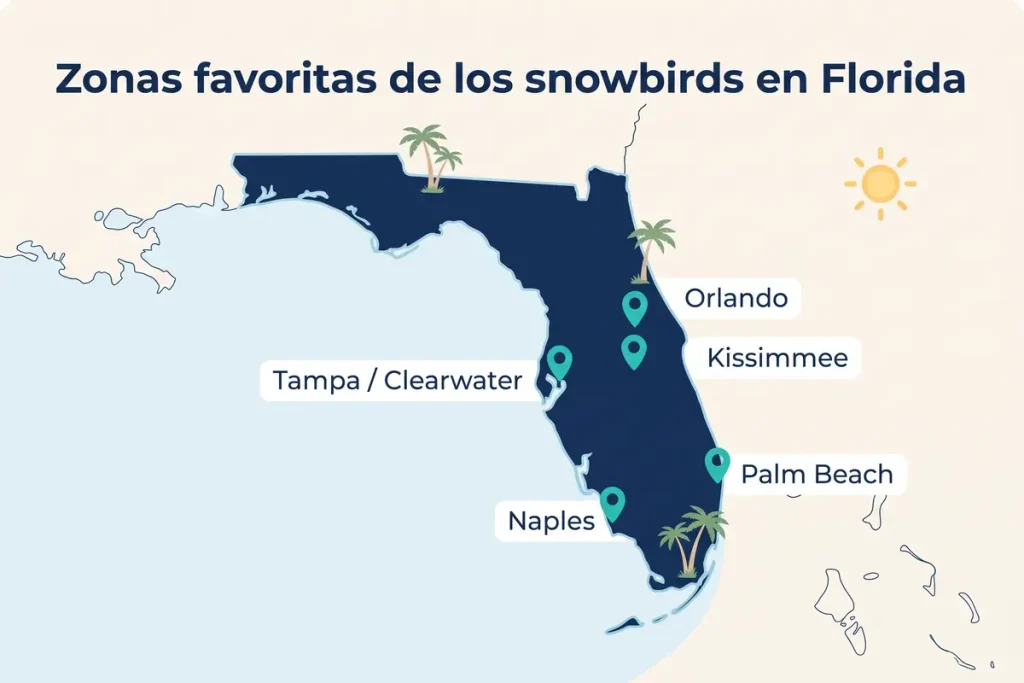
Where to spend the winter, based on how you live
There is no single best area. There are better areas for what you plan to do between December and March.
| Area | Snowbird profile | Winter advantage | What to check |
|---|---|---|---|
| Kissimmee and Davenport | Families with grandkids, buyers who want to rent the rest of the year | Resort communities zoned for short-term rentals | HOA fees and each community’s rules |
| Lake Nona (Orlando) | Retirees who put health and quiet first | Close to the medical campus and Orlando International Airport | Prices above the Orlando average |
| Winter Garden and Clermont | Buyers who want small-town life and green space | Dry, mild winters, bike trails, local markets | Lower demand for short-term rentals |
| Miami (Brickell, Edgewater) | Urban lifestyle, culture, flights to all of Latin America | Highs of 75 to 79 °F in the middle of January | High insurance costs and condo fees |
| Cape Coral and Fort Myers | Value buyers who want to be near the water | More listings as Canadians sell | Hurricane exposure and building age |
If your plan is to spend the winter there and let the property pay for itself in the summer, Kissimmee and Davenport usually come out ahead. If you care more about quality of life and do not mind the house sitting closed for months, Lake Nona and Winter Garden offer something different: residential neighborhoods, year-round neighbors, and less tourist traffic.
What a winter home really costs
This is where many buyers get surprised. A second home in Florida does not qualify for the homestead exemption, which is reserved for the primary, permanent residence of a Florida resident. That means you pay property tax on almost the entire assessed value.
Here is a concrete example: a $360,000 townhouse in Kissimmee, bought in cash.
| Annual expense | Estimate | Note |
|---|---|---|
| Property tax | $5,800 | About 1.6% of assessed value, no homestead |
| Homeowners insurance | $2,800 | Benchmark: Citizens statewide average in 2026, about $2,768 |
| HOA fee | $3,600 | $300 a month, includes common areas |
| Basic utilities while empty | $1,800 | Electricity with scheduled AC, internet, water |
| Preventive maintenance | $3,600 | Rule of thumb: 1% of the home’s value |
| Monthly check-ins while you are away | $1,200 | Visits from a property manager or home watch service |
| Total | $18,800 | About $1,570 a month |
That $18,800 a year is the cost of owning it, not of using it. If you only stay four months, each month you spend there effectively costs you $4,700. That is why the next question is almost unavoidable.
Renting it out while you are gone: summer pays too
In the Orlando area, summer is peak season thanks to the theme parks and U.S. school vacations. A home you use from December to March can be rented in June through August, over the holidays if you skip a trip that year, and during spring break weeks.
Here is the same Kissimmee townhouse, located in a community that allows short-term rentals:
- Nights booked from April to November: 120
- Average nightly rate: $165
- Gross income: $19,800
- Short-term rental management fee (20%): -$3,960
- Cleaning, supplies, and platform fees: -$3,200
- Net income before taxes: $12,640
That income covers roughly two-thirds of the property’s annual cost. It does not turn the home into a big money-maker, but it changes the math: your Florida winter goes from costing $18,800 a year to roughly $6,160.
Two warnings. First, not every community allows short-term rentals, and in the Orlando area the rules vary by county. Second, rental income earned by a nonresident is taxable in the United States, and to report it you will need a taxpayer identification number (ITIN).
Visas, length of stay, and taxes to watch
This is where most mistakes happen. Buying a home in Florida does not give you any immigration rights.
Length of stay. On a B-2 visa, the U.S. Customs and Border Protection officer usually authorizes up to six months per entry, but is not required to. If you are Chilean and travel on ESTA under the Visa Waiver Program, the limit is 90 days per visit. Spending the whole winter, from November to April, is possible on a B-2, but doing it year after year with long stays can raise questions at the border. Always carry proof of your life back home: a job, a pension, your residence, a return ticket.
Tax residency. The IRS uses the substantial presence test: it counts all your days in the current year, one-third of the days from the prior year, and one-sixth of the days from two years before. If the total reaches 183, you could be treated as a U.S. tax resident and owe tax on your worldwide income. A snowbird who spends 150 days a year in Florida for three straight years adds up to 150 + 50 + 25 = 225 days. There is a way out, Form 8840, the closer connection exception statement, but it has to be filed on time and backed up.
Selling later. When you sell, the buyer is required by law (FIRPTA) to withhold 15% of the sale price and send it to the IRS. You recover the difference by filing a tax return.
What is on the November ballot. On November 3, 2026, Florida votes on Amendment 3. If it passes with at least 60% of the vote, the annual cap on assessed value increases for non-homestead property, which includes second homes, would drop from 10% to 5% starting in 2027. For a snowbird, that would mean a more predictable property tax bill over the long run.
How to buy step by step from abroad
The process does not require you to travel more than once, if at all. This is the order we recommend:
- Define how you will really use it. How many months will you stay? Do you want to rent it out the rest of the year? Your answer decides the area and the type of property.
- Check your financing. U.S. lenders that work with foreign buyers usually ask for a down payment of 25% to 40%. If you plan to rent the home, a DSCR loan is underwritten on the property’s cash flow, not on your personal income.
- Choose the ownership structure. Buying in your own name is simpler. Buying through an LLC adds privacy and separates liability, but it comes with annual costs and different tax consequences.
- Search and visit. Many showings can happen over video, but we recommend seeing your top two or three options in person, ideally during the season you plan to use the home.
- Negotiate with data. With 7.7 months of condo inventory, there is room to ask for price cuts or seller credits.
- Close remotely. Remote online notarization and title companies let you sign from your home country.
At every one of those steps, it helps to have someone on the ground. Our team that handles property for sale in Florida works with Latin American buyers from the first call through the handover of the keys, including virtual showings and coordination with lenders and attorneys.
One piece of advice we repeat a lot: buy the home you will enjoy in January, not the one that looks best in an Airbnb listing. If rental income is the main goal, that is a different kind of investment and it should be analyzed with different numbers.
Frequently asked questions about winter second homes
Can I live in my Florida home for six months a year on a tourist visa?
It is possible, but not guaranteed. The immigration officer decides how long you can stay each time you enter, usually up to six months on a B-2 visa. If you repeat long stays every year, be ready to show strong ties to your home country and keep an eye on the IRS substantial presence test so you do not become a tax resident by accident.
Does a second home qualify for the homestead exemption?
No. Homestead only applies to the primary, permanent residence of a Florida resident. A winter home pays property tax on its full assessed value, with a 10% annual cap on assessment increases that could drop to 5% starting in 2027 if Amendment 3 passes.
Which part of Florida is best for a Latin American snowbird?
It depends on how you will use the home. Kissimmee and Davenport work well if you want to rent it out the rest of the year. Lake Nona and Winter Garden are better for quality of life and access to health care. Miami is the urban option, with more flights to Latin America but higher insurance and condo costs.
How much does it cost to keep a winter home empty?
For a $360,000 property in Kissimmee, fixed annual costs run about $18,800, including property tax, insurance, HOA, utilities, maintenance, and check-ins. Renting it during the months you are away can cover about two-thirds of that amount.
Do I need to travel to Florida to close on the purchase?
Not necessarily. With remote online notarization and a title company, you can sign from your home country. Even so, we recommend visiting your final options in person before making an offer.
If you already know which months you want to spend in Florida, the next step is finding a home that fits that calendar. Find your winter home in Florida with an advisor who knows the neighborhoods, the rental rules, and the process for foreign buyers.