For a large share of Latin American investors buying from abroad, a townhouse is the entry point that best balances price, control, and profitability in Florida. It costs less than a single-family home, offers more autonomy than a condo, and remains eligible for most financing programs available to foreign nationals.
This guide answers with real numbers the question that comes up most before buying one: is a townhouse a good investment in Florida in 2026? We cover prices by area, how the HOA fee actually works and how much it affects cash flow, cap rate compared to condos and single-family homes, financing for non-residents, taxes, and the step-by-step remote purchase process.
What is a townhouse, and why consider one in Florida?
A townhouse is a two-or-more-story home that shares at least one wall with the neighboring unit but, unlike a condo, usually includes ownership of the land under the structure (or a portion of it, depending on the community). That distinction sounds technical, but it has real consequences: more control over exterior maintenance in some cases, and generally a lower HOA fee than a comparable condo.
For a foreign investor without US residency, the townhouse works as a middle entry point: the purchase price is usually below that of a single-family home in the same area, but the target tenant (families, young professionals, mid-term visitors) is similar to that of a single-family rental, which sustains rental demand.

Townhouse vs. condo vs. single-family home
The choice among these three property types does not come down to purchase price alone. HOA, financing, and resale liquidity vary quite a bit between them.
| Criteria | Townhouse | Condo | Single-family home |
|---|---|---|---|
| Land ownership | Yes, or a shared portion | No (unit only) | Yes, in full |
| Typical HOA fee | $150 – $400/month | $300 – $700/month | $0 – $150/month (if applicable) |
| Exterior maintenance | Shared with the community | Handled by the association | Owner’s responsibility |
| Financing | Standard, no added restrictions | May require financial review of the building | Most flexible |
| Resale liquidity | Medium to high | Medium, depends on the building | High |
| Typical tenant | Families, professionals | Individuals, young couples | Families |
Broadly speaking, a condo suits someone who prioritizes minimal maintenance and doesn’t mind a higher HOA fee, a single-family home suits someone seeking maximum liquidity and full control, and a townhouse sits in between, attractive to investors who want to balance entry price, a reasonable HOA, and solid rental demand. For a more detailed look at houses versus condos, check our comparison of houses vs. condominiums in Florida.
Townhouse prices in Florida in 2026
Prices vary significantly by area, and should be treated as orders of magnitude rather than exact figures, since each community has its own pricing dynamics.
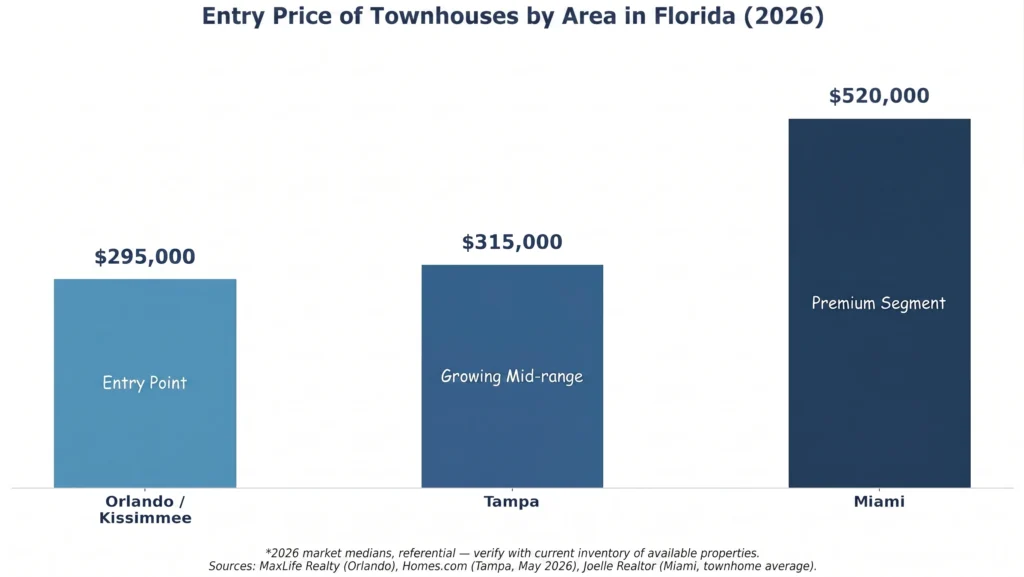
For up-to-date prices on specific available units, the most reliable option is to check our available townhouses inventory, since these ranges shift with current supply.
HOA fees on townhouses: what they cover and how they affect your returns
This is the part almost no other guide quantifies, and it’s the one with the biggest impact on the investment’s real cash flow.
The HOA fee on a townhouse typically covers maintenance of the structure’s exterior (roof, facade, paint), the community’s common areas, insurance on the building’s “shell” (the structure itself, not the interior contents), and in many cases amenities like a pool, gym, or security. The typical monthly range runs from $150 to $400, depending on the community and how many amenities are included.
What often surprises a first-time investor is special assessments: one-time additional charges the association can approve to cover major unbudgeted repairs (a shared roof, repaving internal roads, structural repairs). These charges are not included in the monthly fee and can amount to several thousand dollars in a single payment. Before buying, it’s worth reviewing the association’s meeting minutes from the last two or three years to check for a history of recent or planned special assessments.

When calculating a townhouse’s net cash flow, the HOA fee is subtracted directly from rental income, along with property tax, insurance, and management. Ignoring this deduction is the most common mistake when projecting a townhouse’s profitability against a single-family home with no HOA. It is also important to check the community’s short-term rental rules: many townhouse associations restrict or prohibit Airbnb-style rentals, even when the broader area allows them.
Returns: long-term rental, short-term rental, and cap rate
Cap rate is calculated by dividing the annual net operating income by the property’s purchase price. Net operating income is the gross annual rent minus operating expenses, including HOA, property tax, insurance, and management, not counting the mortgage payment.
A simplified example on a $350,000 townhouse in Orlando with a long-term rent of $2,400 per month ($28,800 annually):
| Item | Annual amount |
|---|---|
| Gross rental income | $28,800 |
| HOA | $3,000 |
| Property tax | $4,900 |
| Insurance | $1,800 |
| Management (10%) | $2,880 |
| Net operating income | $16,220 |
| Resulting cap rate | 4.6% |
At a high level, a condo in the same area and price range usually shows a slightly lower cap rate due to a higher HOA fee, while a single-family home with no HOA usually shows a somewhat higher cap rate, in exchange for a higher entry price and exterior maintenance falling directly on the owner.
Vacation or mid-term rental can generate considerably higher gross income than a long-term lease, but it only makes sense if the community explicitly allows it, otherwise the cap rate analysis becomes irrelevant because the strategy isn’t even viable.
Financing for foreign investors
Buying a townhouse without US residency does not require paying 100% in cash. Foreign national and DSCR programs finance between 60% and 75% of the value, with a typical down payment of 25% to 40% depending on the product and the buyer’s profile.
DSCR loans are particularly useful for townhouses intended for rental, since they qualify based on the property’s projected rental cash flow rather than personal income documented in the buyer’s home country. Neither program requires US credit history. For the full breakdown of products, rates, and requirements, check our financing guide for foreign investors in Florida, and if you already have your budget clear, you can request pre-approval directly with our team.
Taxes and costs to consider
Beyond the purchase price and HOA fee, a townhouse carries the same tax costs as any other real estate investment in Florida: annual property tax (between 0.8% and 2% of assessed value, depending on the county), homeowners insurance, and the 15% FIRPTA withholding on the gross sale price when selling the property. You should also budget for closing costs, between 2% and 5% of the purchase price.
These items apply to residents and foreigners alike, though a foreign investor must also account for filing income tax on rental earnings and, in some cases, the estate tax if the property is held under a personal name. For the full tax picture, check our taxes for foreign investors guide in Florida.
Best areas to buy a townhouse in Florida
Orlando and Kissimmee offer the best entry point for anyone looking for combined tourist and family demand, with accessible prices and solid occupancy in both long-term and vacation rental where the community allows it. To go deeper on this specific area, check our guides to the advantages of investing in townhouses in Orlando and townhouse vs. single-family home in Orlando.
Tampa stands out as an area of sustained growth, with moderate entry prices and a tenant base oriented more toward stable residential rental than tourism. Miami and its surrounding areas concentrate the premium segment, with higher prices but also greater resale liquidity and constant international demand.
Choosing an area depends on your goal: if cash flow from year one is the priority, Orlando and Kissimmee tend to offer a better relative cap rate; if long-term appreciation and liquidity are the priority, Miami tends to perform better, though at a considerably higher entry price.
How to buy a townhouse as a foreigner (step-by-step, remote)
The remote purchase process follows a familiar flow: define your budget and goal, get pre-qualified with a lender if using financing, select the property with the help of an agent who understands the foreign buyer profile, make an offer and negotiate, go through inspection and legal due diligence, sign at closing (which can be done remotely with digital notarization), and register the property under your name or your LLC’s.
Standard documents include a valid passport, proof of funds or income, and recent bank statements. Many investors choose to buy through an LLC to protect their personal assets and simplify succession, though it is not a legal requirement to complete the purchase.
The most common mistakes specific to buying a townhouse are not reviewing the HOA’s rules and meeting minutes before making an offer, and underestimating special assessments when calculating the total budget, two factors that don’t apply the same way to a single-family home with no association.
Frequently asked questions
Is buying a townhouse a good investment in Florida?
It depends on the goal. For an investor looking for a more accessible entry point than a single-family home, with solid rental demand and a reasonable HOA, a townhouse is usually a solid investment. The key is reviewing the HOA fee and the history of special assessments carefully before buying.
How much does HOA cost on a townhouse in Florida?
The typical range is $150 to $400 per month, depending on the community and included amenities. This amount does not include possible special assessments, which are one-time additional charges for major repairs.
Townhouse or condo, which is the better choice?
A townhouse usually has a lower HOA fee and, in many cases, partial or full land ownership, while a condo usually requires less direct maintenance in exchange for a higher fee. The choice depends on how much you value control versus convenience.
Can I rent out my townhouse on Airbnb?
This depends entirely on the homeowners association’s rules, not the city’s general zoning. Many townhouse communities restrict or prohibit short-term rentals, so it needs to be verified before making an offer, not after buying.
Can I buy a townhouse in Florida without US residency?
Yes. No residency, citizenship, or special visa is required. Foreign national and DSCR financing programs are designed specifically for foreign buyers, and closing can be completed remotely.
Invest in a townhouse with the right strategy
A townhouse in Florida can be the ideal entry point for a foreign investor, as long as the decision is made with the full numbers on the table: purchase price, real HOA cost, special assessments, projected cap rate, and financing structure. The difference between a solid investment and a disappointing one is almost never the property type itself, it’s the specific community and the planning done before making an offer.
View available townhouses in Florida or schedule a free investment consultation with our team.