Kissimmee’s short-term rental market in 2026 is large, active, and meaningfully split between properties that perform and properties that sit. The city has approximately 8,881 active STR listings, an average daily rate of $192, and market-wide occupancy running at 57%, above the Florida state average of 54%. Average annual revenue per listing sits around $36,838 based on Rabbu market data (April 2026), while top-performing properties, well-positioned 4 to 6 bedroom homes in resort communities near Disney, regularly generate $65,000 to $90,000 gross annually when professionally managed.
The gap between the median and the top quartile is the most important number in this market. Roughly $45,000 in annual revenue separates a well-optimized property from an underperforming one in the same city. That gap is driven by neighborhood selection, property size, amenities, and management quality, not by luck.
This guide covers the five neighborhoods where the fundamentals for STR investment are strongest in 2026, with current data and practical notes on what drives performance in each zone. For context on the regulatory layer that applies across Osceola County before getting to neighborhood specifics, the full breakdown of Kissimmee and Osceola STR regulations for 2026 covers permitting requirements, Tourist Development Tax rates, and HOA considerations.
| Neighborhood | Property type | Proximity to Disney | Estimated annual revenue | Occupancy profile |
|---|---|---|---|---|
| Storey Lake | Townhomes and villas | 10–15 min | $45,000–$70,000 | High, family-driven |
| Windsor Hills | Villas and condos | 10–12 min | $45,000–$65,000 | Stable, established |
| Reunion Resort | Luxury villas | 15–20 min | $60,000–$90,000+ | High for large units |
| ChampionsGate | Mixed villas and homes | 12–18 min | $45,000–$75,000 | Growing, golf-driven |
| Paradise Palms | Townhomes and villas | 10–15 min | $35,000–$55,000 | Solid, family-focused |
Revenue estimates based on Rabbu April 2026 data, AirROI 2026 dataset, and Airbtics TTM data (Nov 2024–Oct 2025). Actual performance varies by unit size, condition, management, and pricing strategy.
What the 2026 market data actually says about Kissimmee STR performance
Before going neighborhood by neighborhood, a few market-level numbers that matter for investment modeling:
Mid-range properties in the $300,000–$450,000 range, typically 4 to 5 bedroom single-family homes near Disney, generally earn $45,000–$65,000 annually, maintaining 70–80% occupancy at $200–$280 nightly rates. Larger 6 to 8 bedroom luxury homes in resort communities regularly exceed $80,000–$90,000 gross when professionally managed.
Best-in-class properties (top 10%) achieve 87% or higher occupancy. Strong performers (top 25%) maintain 75% or higher. Typical median properties run around 51–52% occupancy. Entry-level properties in the bottom quartile average 26–28%, potentially facing significant vacancy.
Seasonality is real and predictable. April sees the highest demand (peak season occupancy), while September experiences the lowest. December is consistently the highest-revenue month. Planning pricing strategy around this rhythm, premium rates during spring break, summer, and winter holidays; dynamic discounting in September and early October, separates top-performing operators from the median.
Supply grew 106% over the past year, yet revenue and nightly rates both trended upward, a signal that traveler demand is outpacing new inventory rather than being diluted by it. For investors, that means the market is not yet saturated at the top tier, but undifferentiated inventory in the middle is facing more competition.
Storey Lake: the highest-demand resort community for families
Storey Lake consistently ranks among the top-performing STR communities in Kissimmee because it solves the main problem Disney-area travelers have: finding a property large enough for a multi-generational family that is also close to the parks and resort-quality in its own right.
The community offers a clubhouse with a pool, water slides, a lazy river, gym, restaurant, and tiki bar. Properties range from townhomes to villas, most with private pools or access to the community water complex. Drive time to Walt Disney World runs 10 to 15 minutes depending on traffic.
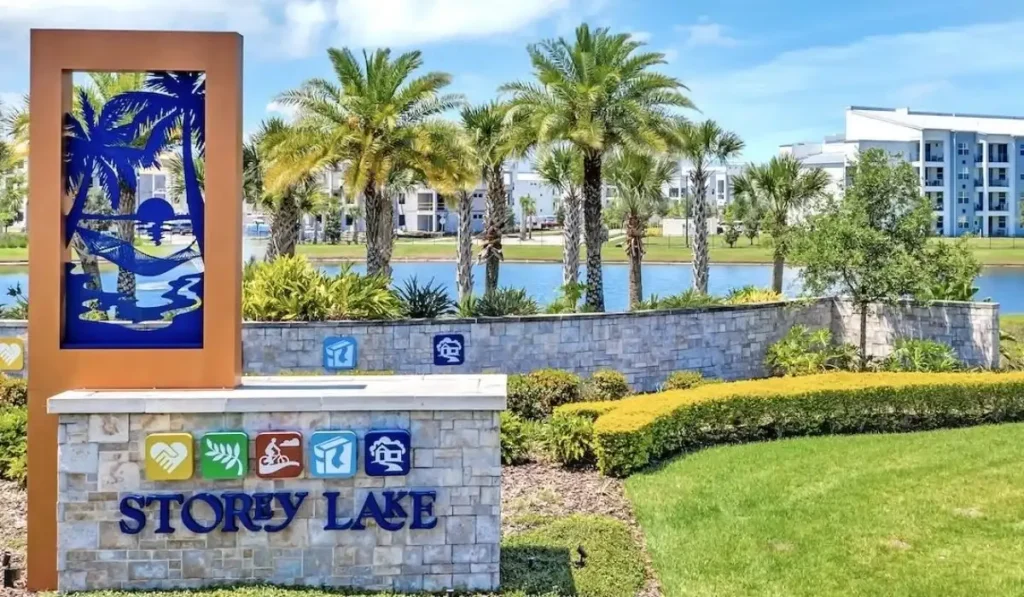
What makes Storey Lake work for investors is the amenity stack combined with the new construction quality. Properties here tend to photograph well, attract families booking 7 to 10 night stays, and hold nightly rates in the $200 to $350 range for 4 to 6 bedroom units during peak season. Occupancy in well-managed units regularly runs at 70 to 80% annually.
The regulatory situation is straightforward for Osceola County resort communities: STR is permitted in the zoning, state DBPR vacation rental license is required, and the Tourist Development Tax applies at 6.5% of gross rent. Always verify current HOA rules before purchasing, as individual community policies can evolve.
Who buys here: Investors targeting families booking Disney trips who want a property that competes on amenities with the established resort communities while offering newer construction.
Windsor Hills: the most established community with the most reliable data
Windsor Hills has operated as a vacation rental community long enough that performance data is reliable and track records exist. That matters when modeling an investment: you are not projecting based on comparable markets, you are looking at real transaction history from the same buildings.
The community includes an Olympic lagoon-style pool, a water park, cinema, gym, and sports courts. Drive time to Disney is 10 to 12 minutes. Properties include a wide range of condominiums and villas, which gives investors options at different price points and sizes.
The key advantage of Windsor Hills for foreign investors is predictability. Buildings with long operating histories have established rental management companies, known HOA structures, and documented reserve fund status, all of which matter for due diligence. The community’s reputation is strong enough that guests book it specifically by name, which means marketing leverage for owners.
The downside relative to newer communities is that some properties are showing their age. Building selection matters here more than in newer developments: a well-maintained 4-bedroom villa with recent renovations performs very differently from a comparable unit that has not been updated in several years.
Who buys here: Conservative investors who prioritize proven track record and established property management infrastructure over growth potential.
Reunion Resort: the luxury tier with the highest revenue ceiling
Reunion Resort operates at a different price point from the other communities in this guide. Three championship golf courses, a water complex, multiple restaurants, and full resort services position it for guests who are not just visiting Disney but want a complete vacation destination in their accommodation.
Properties here are primarily large luxury villas and homes with multiple bedrooms, private pools, and high-end finishes. Nightly rates for 6 to 8 bedroom properties regularly exceed $500 to $700 during peak season, and professionally managed units in this tier generate $80,000 to $90,000 or more annually. The entry price is correspondingly higher, quality villas in Reunion start around $600,000 and run well past $1 million for the larger units.
The investment case at Reunion is not about maximizing occupancy. It is about maximizing revenue per night for a smaller number of high-quality bookings. A 6-bedroom Reunion villa with a private pool might run 55 to 60% annual occupancy and still generate more gross revenue than a smaller property running 80% occupancy in a less premium community.
Regulations at Reunion are consistent with other Osceola County resort communities: STR is zoned as permitted. HOA oversight is more active than at some other communities, which affects operational flexibility but also protects the property values.
Who buys here: Investors with higher entry capital who want maximum revenue per booking and are targeting the family group market spending $3,000 to $7,000 per week on accommodations.
ChampionsGate: the fastest-developing community with golf-driven demand
ChampionsGate is the community in this guide with the most room to run. As of 2026, it continues to develop, with new properties coming to market and its amenity base expanding. The community has two championship golf courses, a water complex with a lazy river and slides, and a growing retail and restaurant corridor.
Drive time to Disney runs 12 to 18 minutes depending on which part of the community. Properties are a mix of villas, townhomes, and single-family homes at various price points.
The investor opportunity in ChampionsGate is partly growth-driven: properties bought now benefit from an amenity base that will continue improving as the community reaches build-out. The golf component also attracts a specific traveler profile, groups that want Disney access but are also planning golf days, which creates demand that extends beyond the theme park season and provides some occupancy buffer during slower family travel months.
The key due diligence point at ChampionsGate: the community contains multiple sub-associations with different STR rules and HOA structures. A property in one section may have different rental restrictions than a comparable unit a few streets away. Verifying the specific sub-association rules for any property you are evaluating is not optional.
Who buys here: Investors comfortable with some development-stage risk who want growth potential alongside a property that already performs, and those targeting the golf-plus-Disney traveler profile.
Paradise Palms: the most accessible entry point in the resort corridor
Paradise Palms offers the lowest entry prices among the communities in this guide without sacrificing the Disney proximity or the resort-community regulatory clarity. Properties are primarily townhomes and villas with private pools or access to the community pool with slides, gym, and clubhouse.
The community attracts family groups visiting the theme parks on tighter budgets relative to Reunion or Storey Lake guests. Nightly rates run lower, typically $150 to $250 for most unit sizes, and annual revenue tends to land in the $35,000 to $55,000 range. Occupancy for well-managed properties tracks the market median.
For investors, Paradise Palms makes sense as an entry point into the Kissimmee STR market where the capital requirement is lower and the mechanics of vacation rental operation can be learned before scaling to higher-priced inventory. It also works as a cash-flow-focused investment where the purchase price keeps the debt service manageable even at moderate occupancy.
The main risk in Paradise Palms is differentiation. The properties are more homogeneous than in Reunion or Windsor Hills, which means competition is more directly price-based. Strong photography, professional management, and responsive guest communication matter more here than in communities where the location itself creates demand.
Who buys here: First-time STR investors optimizing for accessible entry price and positive cash flow, and investors building a portfolio who want a smaller unit alongside larger investments.
What every investor needs to model before buying in Kissimmee
Gross revenue is not net revenue. Property management companies in Kissimmee typically charge 20 to 30% of gross rental revenue, plus housekeeping and supplies. On a property generating $50,000 gross annually, realistic net revenue after management, HOA, property tax, insurance, and maintenance reserves might be $28,000 to $35,000. Model the full cost structure, not just the ADR and occupancy rate.
Insurance costs have risen. Florida’s property insurance market has been under pressure for several years. For STR properties with pools, insurance premiums are higher and some carriers require specific safety features (pool barrier fencing, alarm systems) as a condition of coverage. Budget this accurately before purchase.
Financing through DSCR loans is available. Foreign nationals purchasing Kissimmee investment properties have access to DSCR (Debt Service Coverage Ratio) loans that qualify on the property’s projected rental income rather than personal income. Down payments typically run 20 to 30%. A complete guide to mortgage documentation requirements for foreign buyers in 2026 covers the full qualification picture.
HOA rules are property-specific, not community-wide in some developments. As noted in the ChampionsGate section, some communities contain multiple sub-associations. Verifying the specific HOA documents, reserve fund status, and pending assessments for the exact unit you are purchasing is the due diligence step most investors skip and most often regret.
The Tourist Development Tax applies to all bookings. Osceola County charges 6.5% TDT on gross rental revenue. Airbnb and VRBO remit this automatically for platform bookings, but direct bookings require the owner to collect and remit. If you plan any volume of direct bookings, register with the Osceola County Tax Collector before you go live.
Frequently asked questions
Which Kissimmee neighborhood generates the most revenue per property?
Based on current market data, Reunion Resort produces the highest gross revenue per property, particularly for large 6 to 8 bedroom luxury villas. Mid-range 4 to 5 bedroom properties in Storey Lake and Windsor Hills produce the most consistent returns relative to purchase price, typically in the $45,000 to $65,000 annual gross range. Larger properties in all resort communities outperform smaller units on a per-property basis.
Is Kissimmee oversupplied as an STR market in 2026?
Supply grew significantly over the past year, but revenue and nightly rates both trended upward, which indicates demand is still absorbing new inventory at the top tier. Undifferentiated mid-range properties face more competition. The practical implication: property selection, management quality, and pricing strategy matter more now than they did in 2021 to 2023, when nearly any property in the corridor performed well.
Can a foreign investor buy in these communities?
Yes. All five communities in this guide are in Osceola County, where STR is permitted in resort and tourist zoning without the restrictions that apply in Orange County residential zones. Foreign nationals can purchase through personal ownership or a US LLC, and DSCR mortgage programs are available that qualify on the property’s rental income rather than the buyer’s personal income.
What occupancy rate should I model for a new investment?
A conservative baseline for a well-managed, properly priced 4 to 6 bedroom property in one of these communities is 55 to 65% annual occupancy. Top-performing properties in the market exceed 75 to 87%. Entry-level or poorly managed properties average 26 to 28%. Use the conservative baseline for underwriting and model the upside as achievable with execution.
How far in advance do guests book in Kissimmee?
Booking lead times in Kissimmee are moderate, with most reservations coming 30 to 90 days in advance for the peak season. Spring break and December holiday weeks often book earlier. This rhythm affects how you should manage pricing: setting rates too early on a static price locks in revenue below what dynamic pricing would capture during high-demand periods.
If you are evaluating a specific property or community in Kissimmee and want to understand how the numbers work for your budget and investment strategy, Florida HomeGroup Realty team can walk you through current inventory, management company options, and DSCR financing pathways, no obligation and fully bilingual.