The purchase price is the number everyone looks at. The cost of owning the property is the number that decides whether the investment works. We have seen buyers who calculated their return with the HOA fee and insurance and forgot about property tax without homestead, flood insurance, or the reserve for a new roof. By the end of the first year, the return they expected was cut in half. If you have already reviewed the costs that come up when you buy, in our article on additional expenses of investing in Florida, here we focus on what comes after: what you pay every month and every year while the property is yours.
The expenses that repeat every year
These are the line items that show up on almost any investment property in Florida:
- Property tax. Charged by the county on the assessed value.
- Homeowners insurance. Covers wind, fire, theft, and liability.
- Flood insurance. Sold separately and required in some areas.
- HOA or condo fees. Maintenance of common areas and, in condos, the building’s insurance.
- Utilities. Electricity, water, trash, internet; the owner pays them if the home is vacant or used as a short-term rental.
- Maintenance and reserves. Small repairs plus savings for the roof, air conditioning, and water heater.
- Property management. A percentage of the rent if someone manages the property for you.
- Administrative costs. Accountant, your LLC’s annual report if you have one, short-term rental licenses.
Let’s go through the ones that weigh the most.
Property tax: the cost that surprises foreign owners most
A Florida resident who lives in their home gets the homestead exemption, worth about $50,000 off the assessed value, and their assessed value can only rise by 3% a year at most. A foreign investor gets neither. You pay on almost the full value, and your assessment can rise up to 10% a year.
The rate is expressed in mills. One mill equals $1 for every $1,000 of assessed value. In Orange County, the average total rate in 2025 was around 16.67 mills based on estimates from Florida TaxWatch data, and inside Orlando city limits it rises to about 19 mills because the city adds its own 6.65 mills.
In dollars:

One important update: on November 3, 2026, Florida voters decide on Amendment 3. If it passes with at least 60% of the vote, the annual cap on assessment increases for non-homestead property would drop from 10% to 5% starting in 2027. It does not change what you pay today, but it would make the tax bill more predictable in the years ahead.
Insurance: what owners are paying in 2026
Homeowners insurance in Florida is still expensive compared with the rest of the country, although 2026 brought some relief. Citizens Property Insurance, the state-backed insurer, cut rates starting July 1, 2026, in many counties. In Miami-Dade, the approved average premium dropped 8.6%, from $3,351 to $3,064. The Citizens statewide average is about $2,768.
Three details change the final number quite a bit:
- Roof age. A roof older than 15 years can make the policy more expensive or lead some insurers to decline it.
- Wind mitigation inspection. Hurricane shutters, a well-anchored roof, and impact windows can lower the premium noticeably.
- Flood. Homeowners insurance does not cover flooding. In high-risk zones, the lender requires a flood policy; elsewhere, it is your call, but a cheap one compared with the risk.
In a condo, the association pays for the building’s insurance out of your fees. You only buy an HO-6 policy for the interior of your unit, which usually costs much less.
HOA, condo fees, and mandatory reserves
HOA fees in Orlando single-family and townhouse communities usually range from $100 to $400 a month, depending on what is included. In resort communities in Kissimmee or Davenport, with pools, security, and a clubhouse, higher fees are common.
The condo picture changed starting in 2024. State law now requires periodic structural inspections for buildings three stories or taller and requires associations to fund real reserves for structural components. Many older buildings raised their fees or levied special assessments of tens of thousands of dollars per unit. That partly explains why the median condo price in Florida fell 1.8% in September 2026, to $293,500, while single-family prices went up.
Before buying a condo, always ask for the reserve study, the inspection report, and the minutes from the last few board meetings.
Annual cost for three property profiles
To keep the numbers comparable, we built three typical long-term rental scenarios:
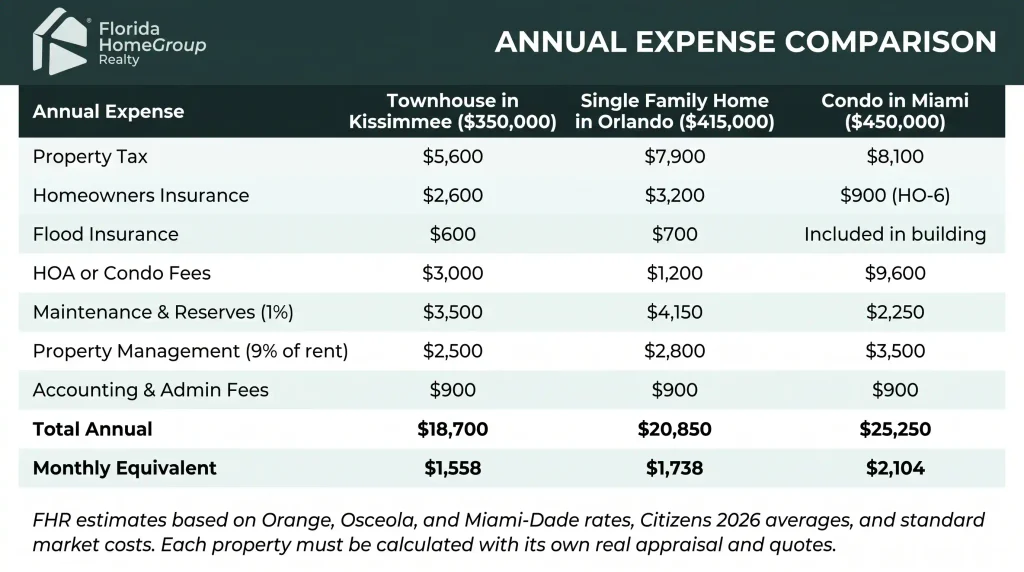
In the condo, maintenance is lower because the association handles the exterior and the structure, but the monthly fee more than makes up for it.

Property management: what it costs and what it includes
If you do not live in Florida, someone has to collect the rent, handle emergencies at 2 a.m., and coordinate repairs. Typical fees in Orlando are:
- Long-term rentals: 8% to 10% of the monthly rent, plus a tenant placement fee that usually equals half a month to a full month of rent.
- Short-term rentals (Airbnb, Vrbo): 18% to 25% of gross income, because it includes guest communication, cleanings, dynamic pricing, and reviews.
It looks expensive until you compare it with the cost of a two-month vacancy or a poorly screened tenant. Through our property rental and management services in Orlando, we work with foreign investors who need clear reports in their language, on-time payments in dollars, and someone who looks after the property as if it were their own.
Full example: from gross rent to net cash flow
Take the $415,000 single-family home in Orlando, bought in cash and rented long term for $2,600 a month.
- Gross annual rent: $2,600 × 12 = $31,200
- Estimated vacancy (one month every two years): -$1,300
- Effective income: $29,900
- Cost of owning the property (table above): -$20,850
- Net cash flow before income taxes: $9,050
- Net return on price (cap rate): 2.2%
If you had run the numbers with only HOA, homeowners insurance, and property tax, you would have estimated $17,600 in net income and a 4.2% return. The gap between what buyers expect and what actually happens comes from maintenance, management, flood insurance, and vacancy.
Does that mean the investment is not worth it? Not necessarily. In Florida, a large part of the return comes from appreciation and from the effect of financing. But cash flow has to be looked at with honest numbers from day one.
How to lower your costs without neglecting the property
There is room to pay less without falling into the trap of putting off repairs:
- Get a wind mitigation inspection. It costs $100 to $200 and can cut your insurance premium by several hundred dollars a year.
- Review your assessment every August. When the county property appraiser’s TRIM notice arrives, compare the value with real sales nearby. If it is inflated, you can appeal.
- Favor newer roofs and AC systems. A home with a roof under 10 years old saves on both insurance and reserves.
- Compare HOA fees before buying. Two neighboring communities can charge very different fees for the same services.
- Do preventive maintenance. Servicing the AC twice a year costs little and helps you avoid $8,000 to $12,000 replacements.
- Bundle your insurance where it makes sense. Some carriers discount homeowners and flood policies placed together, and a higher hurricane deductible can lower the premium if you keep cash reserves to cover it.
Frequently asked questions about the cost of owning a property
How much property tax does a foreigner pay in Orlando?
Without the homestead exemption, the total rate in Orange County is around 16.67 mills, and inside Orlando city limits about 19 mills. On a home assessed at $415,000, that comes to between $6,900 and $7,900 a year.
Does homeowners insurance in Florida cover flooding?
No. Flooding requires a separate policy, from the federal NFIP program or a private insurer. In high-risk zones the lender requires it; elsewhere it is optional but recommended.
How much does a property management company charge in Orlando?
Between 8% and 10% of the monthly rent for long-term rentals, plus a tenant placement fee. For short-term rentals, between 18% and 25% of gross income, because the work is much more intensive.
What percentage of a property’s value goes to maintenance each year?
A common rule of thumb is to set aside 1% of the property’s value each year for repairs and replacements. For older homes or roofs near the end of their useful life, it makes sense to raise that reserve.
Does Amendment 3 lower property taxes for investors?
Not directly. If it passes in November 2026, the annual cap on assessment increases for non-homestead property would go from 10% to 5% starting in 2027, which slows how fast the tax grows in the following years.
Knowing the real cost is what separates a profitable investment from one that keeps you up at night. Get a quote for managing your property and receive an expense and net cash flow estimate built on your property’s actual numbers.