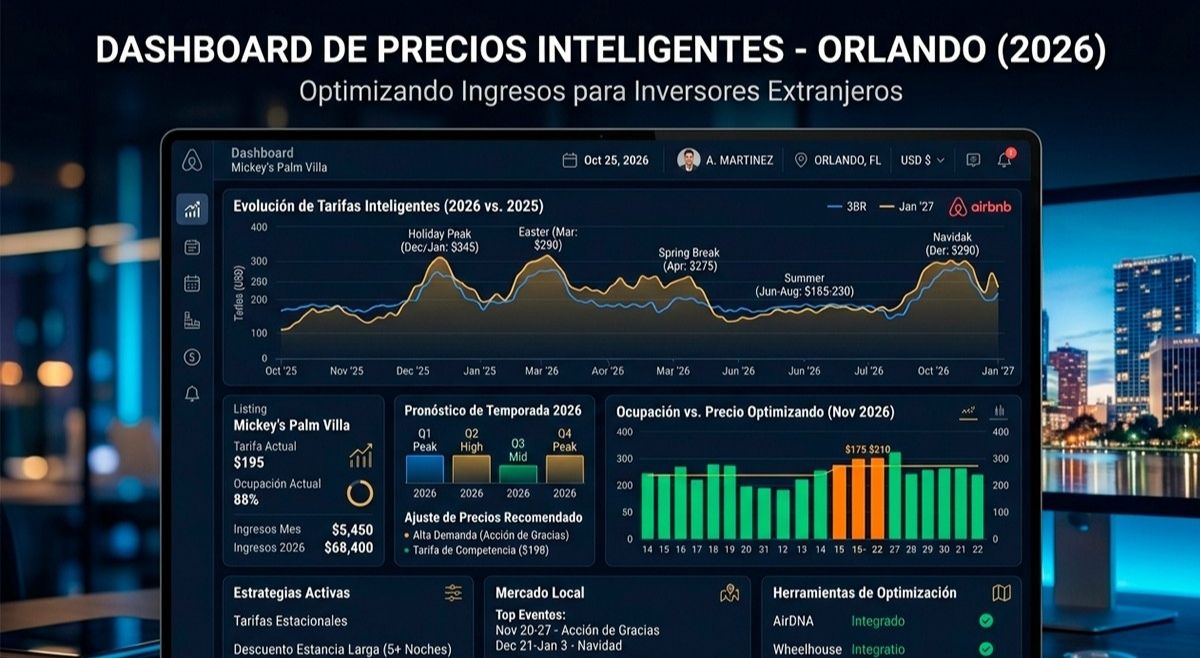
Fixed pricing is the most expensive mistake a host makes in Orlando
There are owners in Orlando charging $120 a night in December and $120 a night in February. The same price for Christmas week and for a Tuesday with no events in the slow season.
That’s leaving money on the table in December and probably sitting with vacancy in February.
The Orlando STR market doesn’t have a single equilibrium price. It has documentable demand peaks — the Christmas period, event weekends at the Orange County Convention Center, spring break weeks — where the market price can triple the base rate. And it has valleys where aggressively dropping the price is the only way to avoid sitting with an empty property.
Dynamic pricing isn’t a luxury strategy for large hosts. It’s the difference between a listing that optimizes its revenue and one that leaves it to chance. In the Orlando 2026 market, with more STR inventory than three years ago and regulations progressively reducing supply in certain zones, price optimization is what separates portfolios that work from those that barely cover costs. If you’re evaluating whether your property is in a zone where STR is still viable in 2026, this article on short-term rental regulations in Orlando by county gives you the updated regulatory map before investing in optimization.
How dynamic pricing works in STR
The logic is the same as a hotel or airline uses: the price changes based on projected demand for each date. What differentiates dynamic pricing from manual adjustment is that the algorithm processes signals no human can monitor continuously.
The signals dynamic pricing tools use for Orlando:
- Historical demand for that same date in previous years in the local market
- Current occupancy of comparable inventory within a certain radius
- Local events — concerts at the Amway Center, conventions at the OCCC, theme park events
- Booking lead time — how many days in advance reservations are being made for that date
- Competitor pricing in real time for similar properties in the same zone
- Day-of-week patterns — Thursdays and Fridays typically have different demand than Mondays in Orlando
The result is a recommended price for each night that updates automatically. Some hosts accept the recommendations without filtering. Others set a minimum floor and maximum ceiling, and let the algorithm operate within that range.
Tools available in 2026
| Tool | Monthly cost | What it does well | Integrations | Typical ROI lift |
|---|---|---|---|---|
| PriceLabs | $19.99–$99/month | Granular customization | Airbnb, VRBO, Booking.com | 15–25% |
| Beyond | ~1% of revenue | Automation | Airbnb, VRBO | 10–20% |
| Wheelhouse | $19.99–$49/month | Easy setup | Airbnb, VRBO | 10–18% |
| Airbnb Smart Pricing | Free | Automatic | Airbnb | Variable |
| DPGO | $13.99–$29.99/month | Low cost | Airbnb, VRBO | 10–15% |
ROI lift is a comparative estimate versus manual fixed pricing. Results vary by property, zone and configuration.
PriceLabs has the largest market share among professional hosts in Orlando — primarily because it allows granularity that other tools don’t. You can create a rule that says: “if fewer than 3 days remain before the date and the night is still available, drop the price 20%.” Or: “in the two December weeks before Christmas, apply a 1.8x multiplier on the base rate.” That level of control is what sets PriceLabs apart.
Beyond is preferred by hosts who want automation without deep configuration. The 1% of revenue model means it scales with your income — in good months you pay more, in slower months you pay less. For small portfolios with low revenue, it can end up more expensive than PriceLabs at a flat price.
Wheelhouse works well for hosts just starting with dynamic pricing who don’t want to spend two hours configuring rules from the start. Less powerful but more accessible.
Airbnb Smart Pricing exists and is free. The real problem: Airbnb’s algorithm optimizes for occupancy, not revenue. It prefers a night booked at $80 over a vacant night at $120. For Airbnb that makes sense — more transactions, more commissions. For you as the owner, not necessarily.
The Orlando calendar — when to raise and when to drop
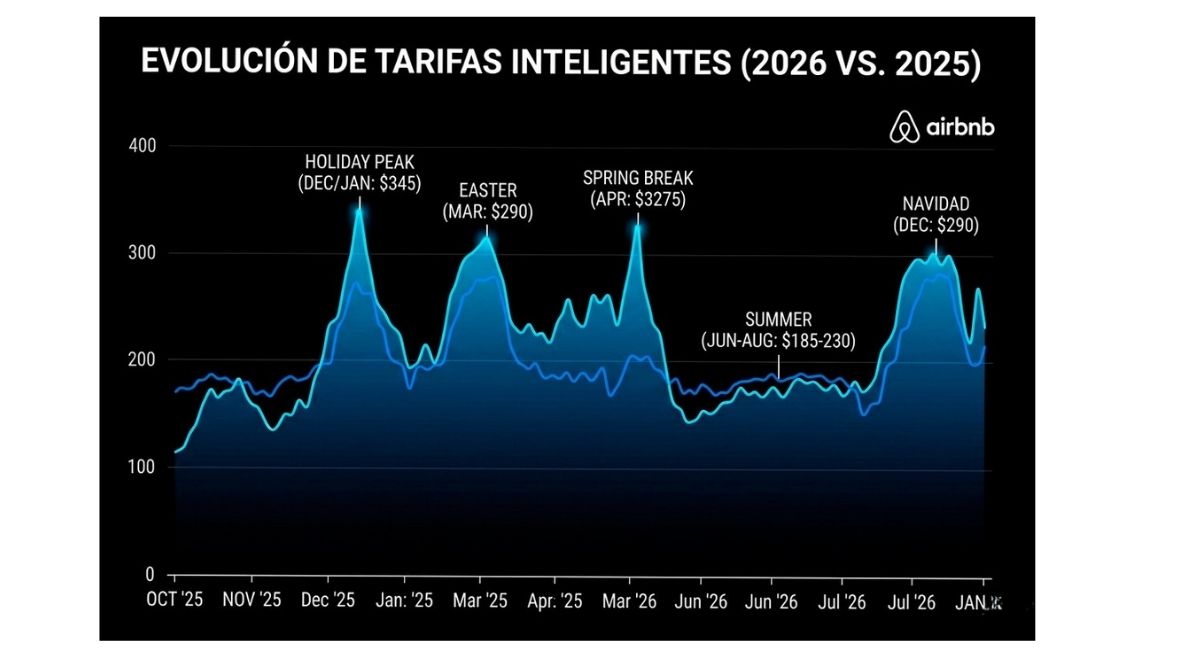
Orlando has one of the most predictable STR demand profiles in the United States. There are dates that fill inventory regardless of price, and there are weeks where no price saves you from vacancy if the base strategy is off.
High season — peak prices:
- Christmas weeks (December 20–January 5): The highest demand period of the year. Theme parks at maximum capacity, families from around the world. Prices can triple the base rate. Near-Disney properties with 3+ bedrooms reach $400–$700/night in that period.
- Spring break (second and third week of March): Families with school-age children. Demand is high and spreads across two or three weeks depending on the northeast states’ school calendars.
- Easter: Variable by year depending on the calendar, but always generates a 7 to 10-day peak.
- Summer (mid-June–mid-August): A long season. Not the highest peak of the year — Florida’s heat discourages some — but demand is sustained. European and Latin American families concentrate their trips here.
- Thanksgiving (week before the 4th Thursday of November): Underestimated by many hosts. It’s the second highest demand period of the year in Orlando.
Lower demand periods — aggressive pricing strategy:
- Post-Christmas January (January 6–31): Sharp drop after the Christmas peak. Prices need to come down to compete.
- September and October: Exception: if there are large conventions at the OCCC, convention weeks have real corporate demand. Outside of that, they’re the slowest months of the year.
- First week of December: Christmas demand hasn’t started yet. A transition week where price needs to adjust downward before the final climb.
Real revenue example with and without dynamic pricing
Reference property: 3-bedroom house in Kissimmee, 6 guests, base rate $150/night without dynamic pricing.
| Period | Available nights | Without dynamic pricing | With dynamic pricing | Difference |
|---|---|---|---|---|
| Christmas week | 7 | $1,050 | $2,940 | +$1,890 |
| Spring break | 14 | $1,800 | $2,730 | +$930 |
| July | 31 | $3,750 | $4,725 | +$975 |
| September | 30 | $2,700 | $2,415 | -$285 |
| Annual estimate | 365 | $38,000 | $48,000 | +$10,000 |
The September example matters: dynamic pricing sometimes generates less gross revenue in a specific period because it drops the price to increase occupancy. What matters is the annual number — and the $10,000 difference in this example covers several years of subscription to any tool.
How to set up dynamic pricing without overcomplicating it
The most common mistake when starting with dynamic pricing is adjusting too many variables at once and losing track of what’s generating what result.
A reasonable initial setup for a new host on PriceLabs or Wheelhouse:
- Define your base rate. It’s not the price you always want to charge — it’s the reference point on which the algorithm applies multipliers. Calculate your base rate as the price that covers your fixed costs at 75% occupancy.
- Set a minimum floor. The price below which you never want the algorithm to go, regardless of vacancy. To cover operating costs without losing money on each booking.
- Set a maximum ceiling. In theory the algorithm should be able to go as high as the market supports, but in practice some hosts prefer a ceiling to avoid setting expectations they can’t meet with their service.
- Activate local event adjustments. Most tools have an integrated event calendar. Activate it and verify that Orlando events are included — the OCCC has a public conventions calendar.
- Let it run 30 days without touching anything. The algorithm needs data from your specific listing to calibrate itself. The first 30 days are a learning period — don’t adjust every week because a Monday didn’t get bookings.
Pricing is just one part of the profitability equation. The other is what happens with the property between reservations — maintenance, cleaning, guest turnover. This guide on property management in Orlando to maximize your investment covers the operational side that determines whether the revenue you capture with dynamic pricing becomes real profit or disappears into avoidable costs.
FAQ
How much more does a property earn?
The typical range reported by tools is 15 to 25% increase in annual revenue versus manual fixed pricing. During peak periods — Christmas week, spring break — the difference can be much higher because fixed pricing misses the moments where the market would pay double or triple. In the slow season, dynamic pricing can drop the price enough to capture bookings that fixed pricing would lose.
Best tool?
PriceLabs is the most used among professional hosts in Orlando for the granularity of its configuration. For a host with a single listing just starting out, Wheelhouse is more accessible. Beyond is a good option if you want automation without deep configuration and your monthly revenue makes the 1% model reasonable. The honest answer is that any of the three is significantly better than using none.
Free option?
Airbnb Smart Pricing is free and automatic. The problem is that it optimizes for occupancy, not revenue — it prefers nights booked at a low price over vacant nights at a high price. For a host starting out who doesn’t want to pay anything, it’s a starting point. For a host who wants to maximize annual revenue, it has a real opportunity cost that usually exceeds the cost of any paid tool.
Do I need it with one property?
Depends on how much time you want to dedicate to manual price adjustment. If you check the market weekly and adjust prices with real data, you can approximate what a tool does. Most single-listing hosts don’t do that — they have a fixed price or adjust it once per season. In that case, yes — the tool pays for its monthly cost with the first peak-season booking it captures at the right price.
Does it work for MTR?
Dynamic pricing tools are designed primarily for short-term STR with high turnover. For MTR — stays of 30 to 180 days — pricing is different: you negotiate a monthly rate that varies less by date and more by duration and tenant profile. PriceLabs has functionality for long stays but it’s not the primary use case. For pure MTR, manual pricing with reference to the local market works reasonably well.
Do you have a listing in Orlando and want to analyze whether your current pricing is leaving revenue on the table?
Visit our contact page or message us on WhatsApp and receive personalized advice based on your investment profile.