
Investing in Florida real estate continues to mean stability, growth, and long-term thinking. Thousands of families and investors from Colombia, Mexico, Peru, Ecuador, Honduras, and El Salvador choose this state for its legal security, economic climate, and quality of life. At Florida HomeGroup Realty, with over 19 years guiding international buyers, we know that investing in the United States is about more than acquiring a property: it is about building wealth and family legacy.
What follows is real market data from 2026, not generic projections, so you can make decisions based on actual information.
Quick summary: what you need to know before reading
- Prices stable or slightly down: median single-family home price of $425,000 (May 2026) per Florida Realtors; in general closings, $394,000 (-1.3% year over year) per HouseCanary.
- Buyer’s market: inventory rose from approximately 4.7 to 7.5 months and homes are taking longer to sell (43 to 84 days). More options and room to negotiate.
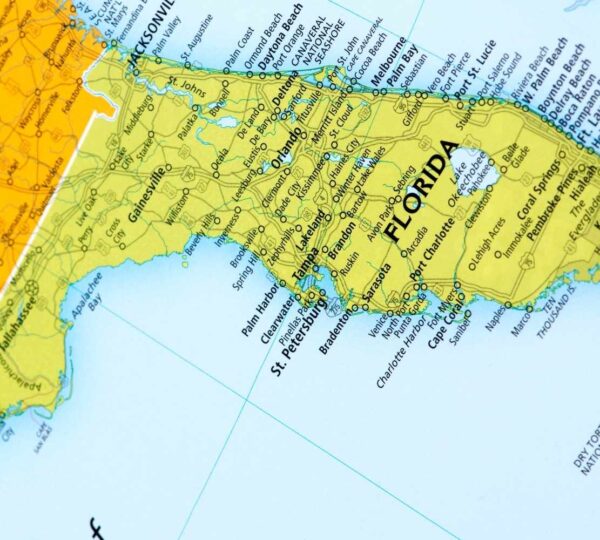
- Differences by zone: Destin (+7.3%), Tampa (+2.5%), and Jacksonville (+1.2%) are rising; Cape Coral (-2.4%), Ocala (-2.7%), and Panama City (-5.8%) are falling.
- Insurance, the big factor: average approximately $11,759 (+7%), though 17 new private insurers entered the market and Citizens is applying an average relief of -8.7%.
- Forecast: prices flat to slightly down (-2.2% over 12 months). No boom, no crash.
A market rebalancing, not collapsing
After years of accelerated appreciation (2020-2023), Florida’s real estate market entered a phase of balance and maturity. According to data from the National Association of Realtors (NAR), Florida Realtors, and HouseCanary, prices stabilized in 2026: the single-family median sits at $425,000, just 1.2% below the all-time high of $430,000 (April 2024), while general closings land at $394,000 (-1.3% year over year).
The urgency that defined the 2021-2022 market is gone. Today buyers have time to analyze, inspect, and negotiate, a margin that investors simply did not have three years ago.
The three zones with the strongest outlook in this cycle are Orlando and Lake Nona, with technology and medical expansion and strong appeal to young families and remote professionals (for a detailed look at how that local market behaves, the Orlando real estate investment guide covers the zones with the highest growth trajectory, the property types with the best performance, and current return profiles); Miami and Brickell, the focus of international investment in premium properties and pre-construction; and Tampa and Jacksonville, mid-tier markets with solid demand and positive appreciation.
Prices by zone in 2026: where they are rising and where they are falling
The rebalancing is not uniform. The markets that rose the most between 2020 and 2022 are the ones offering the largest corrections today and, therefore, the best negotiating opportunities.
| Metro / Zone | Year-over-year change | Investment read |
|---|---|---|
| Crestview-Fort Walton-Destin | +7.3% | Panhandle with limited supply; strong appreciation |
| Tampa-St. Petersburg | +2.5% | Solid demand; price ~$400K stable for 2 years |
| Pensacola | +2.1% | Affordable, less tourist-driven |
| Jacksonville | +1.2% | Employment and migration; 1-5% appreciation |
| Orlando-Kissimmee-Sanford | -0.7% | Balanced; strong in short-term rental and Lake Nona |
| Miami (median $582K) | -1.2% | International demand; condo oversupply |
| Cape Coral-Fort Myers | -2.4% | Correction; negotiating opportunities |
| Ocala | -2.7% | Affordable; lower demand |
| Wildwood-The Villages | -4.0% | Cooling after the boom |
| Panama City-Panama City Beach | -5.8% | Largest correction in the state |
Source: HouseCanary (Q1 2026) and Florida Realtors (May 2026).
Inventory and negotiating power
Homes are taking longer to sell: from 43 days to contract (Florida Realtors, single-family) to a median of 84 days (HouseCanary, general closings), compared to approximately 68 days a year ago. With more inventory and less urgency, a well-advised buyer can negotiate price reductions, seller contributions to closing costs, and rate buydowns, incentives that sellers and builders are now actively offering.
The rise of pre-construction and multifamily
Pre-construction remains one of the best ways to enter the market in 2026. The advantages for the international investor are concrete: lower initial prices, staged payment plans (10-20% during construction), and potential appreciation of 15% to 20% at delivery.
The standout zones are Downtown Orlando and Kissimmee for their proximity to Disney and Lake Nona, and Brickell, Edgewater, and Bal Harbour in Miami. FHR agents, who are also investors themselves, support buyers through developer evaluation, contract conditions, and compliance with the Real Estate Settlement Procedures Act (RESPA).
Rental demand: selective cooling
After years of increases, the rental market cooled in 2026: rents fell approximately 3% year over year due to multifamily oversupply, per Florida Realtors. This is not the end of the rental business, but it does require more selectivity by zone and rental type. Traditional long-term rentals are ideal for stable cash flow; short-term vacation rentals offer high returns in tourist zones, though they are subject to local regulation and face more competition.
Florida home insurance in 2026: why it matters before you buy
Insurance is the single factor that most affects real-world returns in Florida. The average cost runs approximately $11,759 in 2026 (roughly +7% year over year), driven by hurricane risk, litigation history, and insurer exits in prior years. The good news: 17 new private insurers entered the market in 2026 and the state-backed Citizens is applying an average relief of -8.7% on renewals.
Request insurance quotes from the start, before making an offer. That cost alone can completely change the projected cash flow of a property.
Micro-flipping in Florida 2026: real opportunity or miscalibrated risk
Micro-flipping means buying and reselling a property very quickly (days or weeks) without renovating it; the profit comes from data and speed, not construction. It sits between wholesaling (assigning the contract before closing, with minimal capital) and traditional flipping (buy, renovate, sell).
Real opportunities in 2026 include the low entry barrier of wholesaling, institutional build-to-rent demand in counties like Duval (Jacksonville) for 3/2 homes near medical corridors, and local micro-economies that generate exploitable spreads when read with precise data.
The challenges are equally real: zone volatility (sharp drops in some markets make LTV-only bets risky), closing speed (45-60 day bank cycles often kill the deal), and HOA special assessments triggered by Milestone inspections, which can turn a cheap condo at auction into a very expensive purchase.
For most foreign investors, managed rental or selective flipping with a local team makes more sense than micro-flipping. At FHR we evaluate with you whether an operation like this has real numbers before committing capital.
New urban development poles
Florida continues expanding north and inland with planned communities and sustainable projects. The most relevant emerging zones are Lake Nona as a medical and technology innovation hub, Downtown Tampa with urban renewal integrating offices, residences, and green spaces, Coral Gables and Doral with expanding family and commercial projects, and West Palm Beach with strong appreciation and the arrival of financial firms. According to Moody’s Analytics, population growth in Florida will exceed 1.3% annually, continuing to drive construction and residential demand.
Technology and digitalization: the new standard for international transactions
The digitalization of the real estate process is here to stay. Digital closings (e-Closings) with certified electronic signatures, 3D virtual tours for foreign buyers, and secure payment and escrow platforms are already the standard, not the exception. At FHR we implement solutions that comply with RESPA and NAR ethical standards, ensuring transparency in every international transaction.
Latin American investors: the engine of Florida’s growth
According to the NAR, 18% of international transactions in Florida come from countries including Colombia, Mexico, Peru, Ecuador, Honduras, and El Salvador. The most common motivations are dollar-denominated wealth diversification, protection against local inflation, rental income generation, and estate planning for children or retirement.
We have guided hundreds of Latin American families through their first Florida investment, helping them establish secure legal and tax structures through 360° advisory covering legal, accounting, immigration, and management needs. One of the most frequent questions in that process is how to access financing from abroad: the mortgage financing guide for foreigners in Florida explains the loan types available, documentation requirements, and how much initial capital is actually needed to close.
Strategic opportunities for 2026
| Segment | Estimated return | Standout zones |
|---|---|---|
| Multifamily properties | 6% – 8% | Orlando, Tampa |
| Luxury pre-construction | 10% – 12% (appreciation) | Brickell, Edgewater, Bal Harbour |
| Vacation rental | 7% – 9% | Kissimmee, Davenport |
| Family residential | 5% – 7% | Lake Nona, Winter Garden |
Source: FHG Realty internal projections 2025-2026 based on NAR and Florida Realtors data. Percentages are market approximations, not return guarantees.
Forecast: what will happen to Florida prices in 2026 and 2027
Models point to flat to slightly lower prices: HouseCanary projects approximately -2.2% year over year over 12 months and an average of roughly -1.5% annually over three years, with the state remaining in buyer’s market territory while supply exceeds 6 months. For the long-term investor, a sideways market with more inventory is a good time to enter by negotiating, not to speculate on quick resales.
Expert advice from FHR for investing in this market
Start by evaluating your financial profile: define whether you are looking for cash flow, appreciation, or diversification, because the answer changes the strategy entirely. Location can account for up to 70% of an investment’s success, so zone analysis is not a preliminary step, it is the process itself. Get legal and tax advice from the start to protect your assets with the right structure, typically an LLC. And work with a team that also invests: a good agent does not just sell, they guide and educate.
Frequently asked questions
How is the Florida real estate market doing in 2026?
It is a buyer’s market: more inventory, homes taking longer to sell, and prices stable to slightly lower. The single-family median is around $425,000 and inventory sits between 4.7 and 7.5 months depending on the measurement.
Will prices fall in Florida in 2026 and 2027?
The most likely scenario is flat to slightly lower prices (around -2.2% over 12 months), without a collapse. There are no signals of a crisis, but no signals of accelerated recovery in the short term either.
What is micro-flipping and does it make sense in Florida in 2026?
It means buying and reselling very quickly without renovating, relying on data and speed. In 2026 it is viable but risky; for most foreign investors, managed rental or selective flipping with a local team tends to make more sense.
How much does a property in Miami cost in 2026?
The Miami median is approximately $582,000 in 2026 (-1.2% year over year). In premium zones like Brickell or Coral Gables, prices frequently exceed one million dollars.
Why is home insurance so expensive in Florida and will it come down?
Hurricane risk, litigation history, and insurer exits drove costs up. In 2026 the average runs approximately $11,759, but 17 new insurers entered the market and Citizens is applying an average -8.7% relief on renewals.
How does pre-construction work in Florida?
You reserve the property with an initial deposit and make staged payments during construction. At completion, you pay the remainder and receive the deed. It is the most popular entry model for foreign investors due to its staged capital structure.
What taxes does a foreigner pay when investing in Florida?
It depends on the legal structure and how the property is used. The main ones are property tax (annual payment to the county) and FIRPTA (15% withholding on the sale price when transferring). At FHR we work with certified accountants to ensure tax compliance from the start.
Ready to invest in Florida in this buyer’s market? Schedule a consultation with Florida HomeGroup Realty and we will guide you through zone selection, financing, structuring, and property management from start to finish.