Before publishing your first listing, there’s paperwork to do
The vacation rental license in Florida is not optional and it’s not something you can regularize after you start operating. It’s a prior legal requirement. Operating without it exposes the owner to fines, suspension of operations, and in cases of repeat violations, sanctions that complicate any future license.
The process is manageable. It doesn’t require an attorney in most cases, doesn’t require physical presence at almost any step, and the total cost is reasonable. What it does require is doing it in the correct order — there are dependencies between steps that, if skipped, generate delays of weeks. That’s not an abstract warning: the most common mistake is starting the DBPR application without having the EIN, getting halfway through the form, and discovering there that the EIN is going to take three more weeks.
The realistic timeline to complete everything from scratch is 4 to 6 weeks. For foreign investors without a Social Security Number, the IRS EIN step is what determines how long everything else takes. If you’re still evaluating which county and zone type makes the most sense to operate in before starting this process, the article on short-term rental regulations in Orlando 2026 by county gives you the complete regulatory map for Orange, Osceola and Seminole.
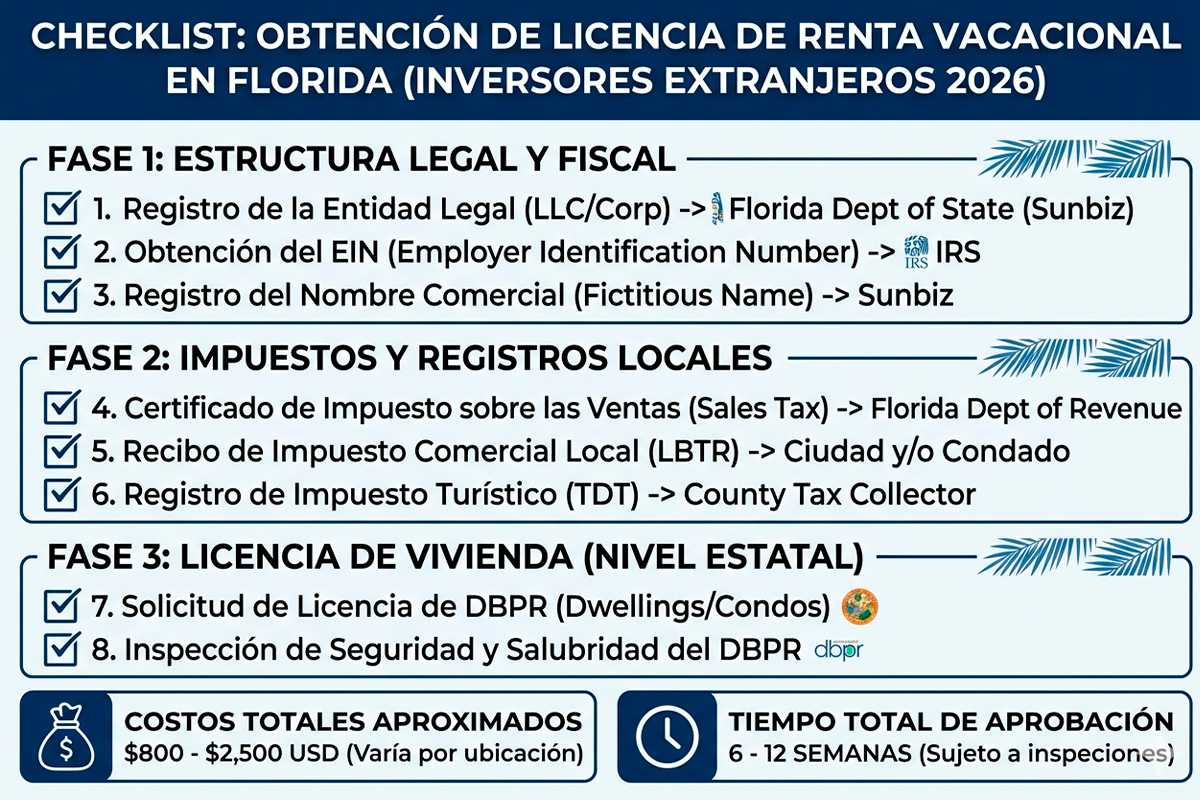
The 10 steps in order
Step 1: Determine the type of license you need
The DBPR has different categories depending on property type. Identifying the right one before starting avoids applying for the wrong license and repeating the process.
- Vacation Rental Dwelling Unit: Single-family home, townhouse, or individual unit outside a complex with a collective license
- Vacation Rental Condo: Condominium within a complex — may have a collective building license or individual per unit
- Vacation Rental Timeshare: For properties with a timeshare structure
Most foreign investors in the Orlando area fall into the first two categories. If you’re not sure which one applies, the DBPR portal has a classification guide — or you can call directly, which is faster than trying to figure it out on your own.
Where: myfloridalicense.com/DBPR | Cost: $0 | Time: 1 day
Step 2: Register or verify the LLC
If you bought the property in the name of a Florida LLC, the LLC must be active and in good standing before starting the DBPR application. If it’s in bad standing due to an unpaid Annual Report, the DBPR rejects the application without much explanation — and discovering that mid-process costs time.
Verifying the LLC’s status takes two minutes on sunbiz.org. If it’s in bad standing, the Annual Report is paid online and updates in 1 to 3 business days.
Where: sunbiz.org | Cost: $125 new LLC / $138.75 overdue Annual Report | Time: 1–3 business days
Step 3: Obtain the EIN from the IRS
The EIN is the tax identification number the IRS assigns to entities and individuals who need to identify themselves for U.S. tax purposes. The DBPR requires it to process the license.
For residents with an SSN, the EIN is obtained online in minutes. For foreigners without an SSN, there are three options — and none of them are as fast as you’d like:
- Via fax (Form SS-4): You send the form to the IRS fax for international applications. The IRS returns the EIN by fax in approximately 4 weeks. It’s the most used method and the most predictable.
- Via international phone (+1 267-941-1099): The IRS has a line for international entities. The EIN is delivered on the same call if everything is in order. Hours are limited, the wait can be long, and sometimes the call doesn’t connect on the first try — but when it works, it’s the fastest method.
- Via postal mail: 4 to 8 weeks. Only if there’s no alternative.
Start this step before any other. It’s the bottleneck of the entire process.
Where: irs.gov (Form SS-4) | Cost: $0 | Time: Immediate with SSN / 2–4 weeks for foreigners
Step 4: Register with the Florida Department of Revenue
Before operating any business that generates taxable rent in Florida, you need to register with the Florida Department of Revenue to obtain a Certificate of Registration. This registration enables you to collect and remit Florida Sales Tax and the Tourist Development Tax.
The process is online and takes less than an hour if you have your EIN ready. Without the EIN, you can’t complete it.
Where: floridarevenue.com → “Register a Business” | Cost: $0 | Time: 1–2 business days
Step 5: Complete the DBPR license application
With the LLC active, EIN in hand, and Revenue registration completed, you’re ready for the main application on the DBPR portal.
You’ll need:
- Property address, number of units, maximum guest capacity
- Owner or entity name and EIN
- Information on the person responsible for operations if it’s not you directly
- Declaration of compliance with habitability and safety requirements
The application generates a case number immediately. The license is issued after review — in most cases it’s fast, but it may request additional documentation depending on the case.
Where: myfloridalicense.com/DBPR → “Apply for a License” | Cost: $150–$300 | Time: 1–5 business days after complete application
Step 6: Register for the county Tourist Development Tax
This is the step most frequently skipped — and it’s where tax liabilities accumulate that show up months later when the county audits.
Although Airbnb and VRBO remit the TDT automatically for platform bookings, direct bookings are the owner’s responsibility. And even for platform bookings, being registered is a requirement in many counties.
- Orange County: occompt.com → Tourist Tax Division
- Osceola County: osceolaclerk.com → Tourist Development Tax
- Seminole County: seminolecountyfl.gov → Tax Collector
Cost: $0 to register / the tax is 5–6.5% on gross rent | Time: 1–2 days
Step 7: Obtain the municipal permit if applicable
If the property is within an incorporated city — the city of Orlando, Kissimmee, Sanford — there may be an additional municipal registration or permit.
The city of Orlando has its own vacation rental registration system, which costs between $250 and $500 annually and includes a habitability inspection. Kissimmee has a similar process. Not all cities in the area require it — verify with the planning or licensing office of your specific city before assuming it doesn’t apply.
This is the most time-variable step. Some cities resolve it in days. Others take weeks.
Cost: $0–$500 | Time: 2 days to 4 weeks depending on municipality
Step 8: Verify safety requirements
- The DBPR requires vacation rentals to meet basic safety standards. There’s no mandatory prior inspection in all cases for Dwelling Units, but there’s a compliance declaration in the application and the DBPR can inspect without prior notice.What needs to be in order before operating:
- Functional smoke detector in each sleeping area and hallways
- Carbon monoxide detector if there’s gas heating or an attached garage
- Accessible fire extinguisher
- Emergency exits unobstructed
- Electrical and plumbing installations in safe condition
- If there’s a pool: safety barriers per the Florida Pool Safety Act — this is not optional and non-compliance fines are independent of the DBPR’s
Cost: Variable | Time: 1 day if everything is already in order
Step 9: Review HOA rules
It’s not a state or county procedure — but it goes here because it’s the one that most frequently causes problems after having all the official permits.
An HOA can prohibit short-term rental in its bylaws completely independently of what the state and county permit. If the HOA prohibits it and you operate anyway, it can fine you, sue you, and initiate a foreclosure process for non-compliance. Having the DBPR license doesn’t protect you from the HOA — they’re two separate systems.
The CC&Rs (Covenants, Conditions & Restrictions) should be available in the county registry or through the HOA administrator. Read them before assuming everything is fine. To understand how HOA rules affect the profitability and operation of your property beyond STR, this article on the impact of HOAs on real estate investment in Florida covers the most common scenarios foreign investors encounter.
Cost: $0 | Time: 1 day
Step 10: Activate the listing
Airbnb, VRBO and most platforms in Florida require listings to include the DBPR license number. It’s in the “Local laws and regulations” field in Airbnb’s listing settings, and in a specific field on VRBO.
There’s no excuse for not including it from day one — if you have the license issued, you have the number.
Cost: $0 | Time: 30 minutes
Summary: costs and timelines
| Step | Estimated cost | Estimated time |
|---|---|---|
| 1 | $0 | 1 day |
| 2 | $0–$155 | 1–3 days |
| 3 | $0 | Immediate / 2–4 weeks |
| 4 | $0 | 1–2 days |
| 5 | $150–$300 | 1–5 days |
| 6 | $0 | 1–2 days |
| 7 | $0–$500 | 2 days–4 weeks |
| 8 | Variable | 1 day |
| 9 | $0 | 1 day |
| 10 | $0 | 30 minutes |
| Total | $150–$955 | 4–6 weeks |
The order matters — and nobody explains it well
There’s a chain of dependencies that isn’t obvious until you hit it in practice:
- Without the EIN you can’t complete the Revenue registration
- Without the Revenue registration some DBPR cases stay incomplete
- Without the DBPR issued some municipal permits don’t advance
- Without the license issued you can’t operate or activate the listing
The correct sequence: active LLC → EIN → Revenue registration → DBPR → county and municipality in parallel.
Starting the DBPR before having the EIN is the most common mistake. The form lets you advance to a certain point — and then the EIN field appears. If you don’t have it, the process stays paused until it arrives. Three or four weeks lost because you didn’t start the EIN first.
FAQ
How long does it take?
Between 4 and 6 weeks from scratch without complications. The bottleneck for foreigners without an SSN is the IRS EIN — it can take 2 to 4 weeks via fax. The DBPR application itself resolves in 1 to 5 business days once you have all prerequisites. The municipal permit, if it applies in your city, can add 2 to 4 more weeks.
How much does it cost?
Between $150 and $955. The base cost — DBPR only — is $150 to $300. If you’re in the city of Orlando and need the municipal permit, add up to $500. If you register a new LLC, add $125. Revenue and county TDT registrations are free.
Can it be done online?
Almost everything. DBPR, SunBiz, Florida Revenue and the county TDT registration are online. The EIN application for foreigners without an SSN is by fax — not in-person but not fully digital either. Some municipal permits still have in-person steps depending on the city, though the trend is toward online processes.
Does it renew?
Yes. The DBPR license expires every year. The DBPR sends a reminder by email, and the renewal process is simpler than the initial application. Operating with an expired license carries the same penalties as operating without one.
Can I operate while waiting?
No. The license must be issued before activating the listing and receiving guests. The license number goes in the listing from day one — without an issued number, there’s nothing to include. Airbnb and VRBO can deactivate listings without a license number in Florida.
Multiple properties?
Each property requires its own DBPR license. There’s no general license covering multiple addresses. If the properties are in the same LLC, the LLC manages one license per property. The process and cost repeat for each one.
Are you in the process of obtaining your vacation rental license in Florida?
Visit our contact page or message us on WhatsApp and receive personalized advice based on your investment profile.