
Not everyone wants to be a landlord — and there’s a solution for that
Buying a property in Florida involves management: finding tenants, coordinating repairs, dealing with vacancies, renewing leases. For many foreign investors that level of involvement isn’t viable — they live in another country, don’t speak English fluently, or simply prefer their capital to work without them having to work too.
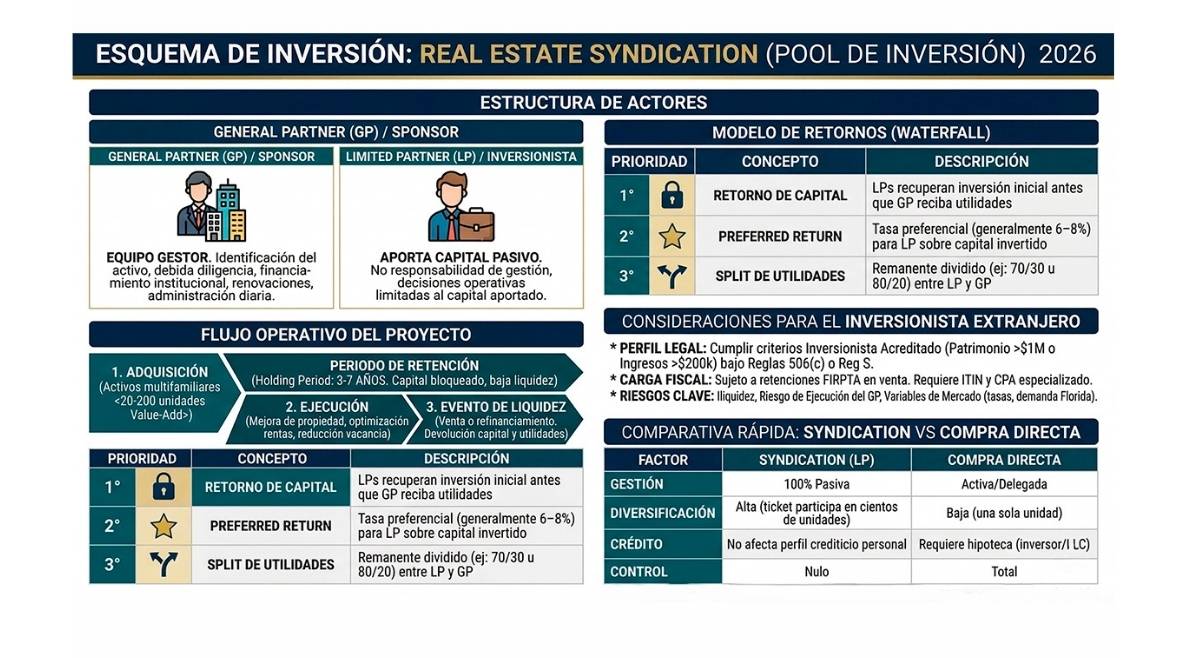
Real estate syndication exists exactly for that profile. You don’t buy a property — you buy a stake in a partnership that buys the property. A team of professionals (the General Partner or GP) manages everything: acquisition, renovation, administration, eventual sale. You as a Limited Partner (LP) contribute capital and receive returns proportional to your participation, without touching a screwdriver or reviewing a lease agreement.
It’s real estate investment in fully passive mode. And in the Orlando 2026 market, with several active funds in multifamily and new developments, it’s a real option — not just a theoretical one. If you’re evaluating whether this model fits your profile before comparing it with direct ownership, this analysis of investment strategies for foreigners in Florida gives you the complete framework to decide with clarity.
How a syndication works step by step
The process has a standard structure in the American market:
- The GP identifies a property (generally multifamily with 20–200+ units) with value-add or development potential.
- Structures the deal: capital contribution, LPs search, and the business plan (3–7 year horizon).
- Offers the stake to LPs under SEC Rule 506(b) or 506(c).
- LPs contribute capital and receive units/participation.
- The GP executes the plan: buys, manages, and improves the asset.
- At the end of the horizon, the GP distributes gains according to the agreed waterfall.
The key term is preferred return: many syndications guarantee LPs a preferential rate (typically 6–8% annually) before the GP receives their share of equity. It is the priority order in the distribution.
Syndication vs direct purchase: what works for your profile
| Factor | Syndication (LP) | Direct purchase |
| Minimum investment | $25,000–$100,000 | $70,000–$120,000 |
| Control over the asset | None — GP decides | Total — You decide |
| Management required | Zero — Passive | High — Active |
| Capital liquidity | Low — Locked 3-7 years | Medium — Can sell/refi |
The critical point: legality for foreign investors
In the United States, syndications are regulated by the SEC. You can’t simply wire money; there’s a specific legal process involving Rules 506(b), 506(c), or Reg S (Offshore).
Note: Before investing, verify with a securities attorney whether the fund accepts non-resident investors. The “accredited investor” definition (income > $200k or net worth > $1M) is often the standard for entry.
What types of properties go into syndications in Orlando
| Asset type | Characteristics | LP investment range |
| Multifamily 20–100 units | Value-add: buy, renovate, sell. | $50,000–$150,000 |
| Ground-up development | Build from scratch. Higher ROI potential. | $100,000+ |
| NNN commercial | Triple-net tenants (Walgreens, etc.). | $50,000–$200,000 |
How returns are distributed — the waterfall
The waterfall defines the split. Usually, LPs recover 100% of capital first, followed by the preferred return (6–8%), a GP catch-up, and finally a split of remaining equity (typically 70/30 or 80/20 in favor of LPs).
Platforms and sponsors active in the Florida market
Recommendation for foreign investors: start with local private sponsors in Florida who have experience working with international LPs. Large platforms like Crowdstreet often have more rigid regulatory hurdles for non-residents than boutique private funds.
Real risks that no pitch deck mentions
- Total illiquidity: You cannot recover capital before the fund exits.
- GP dependency: Success depends on the team’s quality and honesty.
- Market risk: Fluctuations in the Orlando market during the hold period.
Minimum due diligence before committing capital
-
- Read the full PPM (Private Placement Memorandum).
- Verify the GP’s track record and references.
- Consult a CPA specialized in FIRPTA. For numbers, see our
tax guide for foreigners in Florida.
FAQ
What is real estate syndication in simple terms?
A group of investors (LPs) provides capital for a management team (GP) to buy, operate, and eventually sell a large property that none could buy alone.
Is it legal for a foreigner to invest in a U.S. syndication?
Yes, usually under Rule 506(c) or Reg S structures. However, you must verify if the specific fund accepts non-resident investors.
What’s the minimum investment in a syndication?
It ranges from $25,000 to $100,000 in most Florida funds targeting individual LPs. Institutional funds may require $250,000 or more.
How long is capital locked in a syndication?
The typical horizon is 5 years, ranging from 3 to 7 depending on the project type (value-add vs. development).
What are the main risks for a foreigner?
Illiquidity, dependency on the GP, and tax complexity (FIRPTA). A specialized CPA is essential before entering the deal.
Is a syndication better than buying a property directly?
Direct ownership offers control and scaling via equity; syndication offers 100% passive growth. Both can co-exist in a mature portfolio.
Visit our contact page or message us on WhatsApp for personalized advice based on your profile.