Mexico and Florida have a more active real estate relationship than most people realize. Mexican investors are one of the most significant groups of foreign buyers in the Florida market, particularly in Miami and the vacation areas of Orlando. This is not a new trend, but in 2026 there are specific conditions that make it worth analyzing whether it makes sense for your situation.
This article is not a sales pitch. It is a practical guide on how the process works from Mexico: how to transfer funds legally, what financing options exist, how to structure the purchase and what mistakes are most common among first-time Mexican buyers entering the market.
Why Mexican investors choose Florida
Practical reasons first.
Florida has no state income tax. The Mexican peso has had periods of strength against the dollar in recent years, which has improved the purchasing power of Mexican buyers in American markets. Direct flight connections between Mexico City, Guadalajara, Monterrey and the airports in Miami and Orlando are frequent. And the vacation rental market in areas like Kissimmee has demand from Mexican families traveling to Disney who prefer to rent homes rather than hotels.
The strategic reason is diversification. Holding assets in dollars in a market with a solid legal framework reduces exposure to peso volatility and to Mexico’s political cycles. That is not speculation: it is basic risk management for any investor with significant capital.
If you want to understand how to legally structure an investment in Florida from the start, our guide on how to open an LLC in Florida explains the process step by step.
How to transfer money from Mexico to Florida legally
This is where most questions arise and where most mistakes happen. Transferring money from Mexico to the United States for a real estate transaction is legal, but it has requirements that must be met from the beginning.
International bank wire transfer This is the standard method for real estate transactions. Your bank in Mexico sends the funds directly to the title company’s escrow account in Florida. Mexican banks have limits and procedures for international transfers that vary by institution. Some require documentation of the destination of the funds, especially for significant amounts.
The exchange rate your Mexican bank applies is almost always less favorable than the interbank reference rate. On a $300,000 transaction, that difference can be several thousand dollars. It is worth comparing with a currency broker before making the transfer.
Proof of funds origin American financial institutions have a legal obligation to verify that funds come from a legitimate source. This is not suspicion — it is standard procedure that applies to all foreign buyers. The most common documents requested are:
- Bank statements from the last 6 to 12 months
- Tax returns (SAT) for the last 2 years
- Documents proving the source of funds: property sale, business liquidation, inheritance, accumulated savings
- In some cases, an explanatory letter about the source of funds
Having this documentation organized before starting the process speeds up the closing and avoids last-minute delays that can complicate the contract.
Financing options for Mexican buyers in Florida 2026
| Loan type | Down payment required | Main documentation | Advantage | Limitation |
| Foreign national loan | 25% – 35% | Passport, bank statements, MX income | Accessible without US credit history | Higher rate than resident |
| DSCR loan | 20% – 30% | Projected property income | Does not depend on personal income | Requires rental income analysis |
| Cash purchase | 100% | Proof of funds origin | No debt, faster closing | Ties up all capital |
| Loan with MX collateral | Variable | Depends on asset in Mexico | Can free capital without selling | Complex, not all banks offer it |
The DSCR (Debt Service Coverage Ratio) is a loan type that evaluates the property’s ability to cover the debt with its own rental income, without depending directly on your personal income in Mexico. It is especially useful for investors who have capital but whose documented income is difficult to show to an American bank.
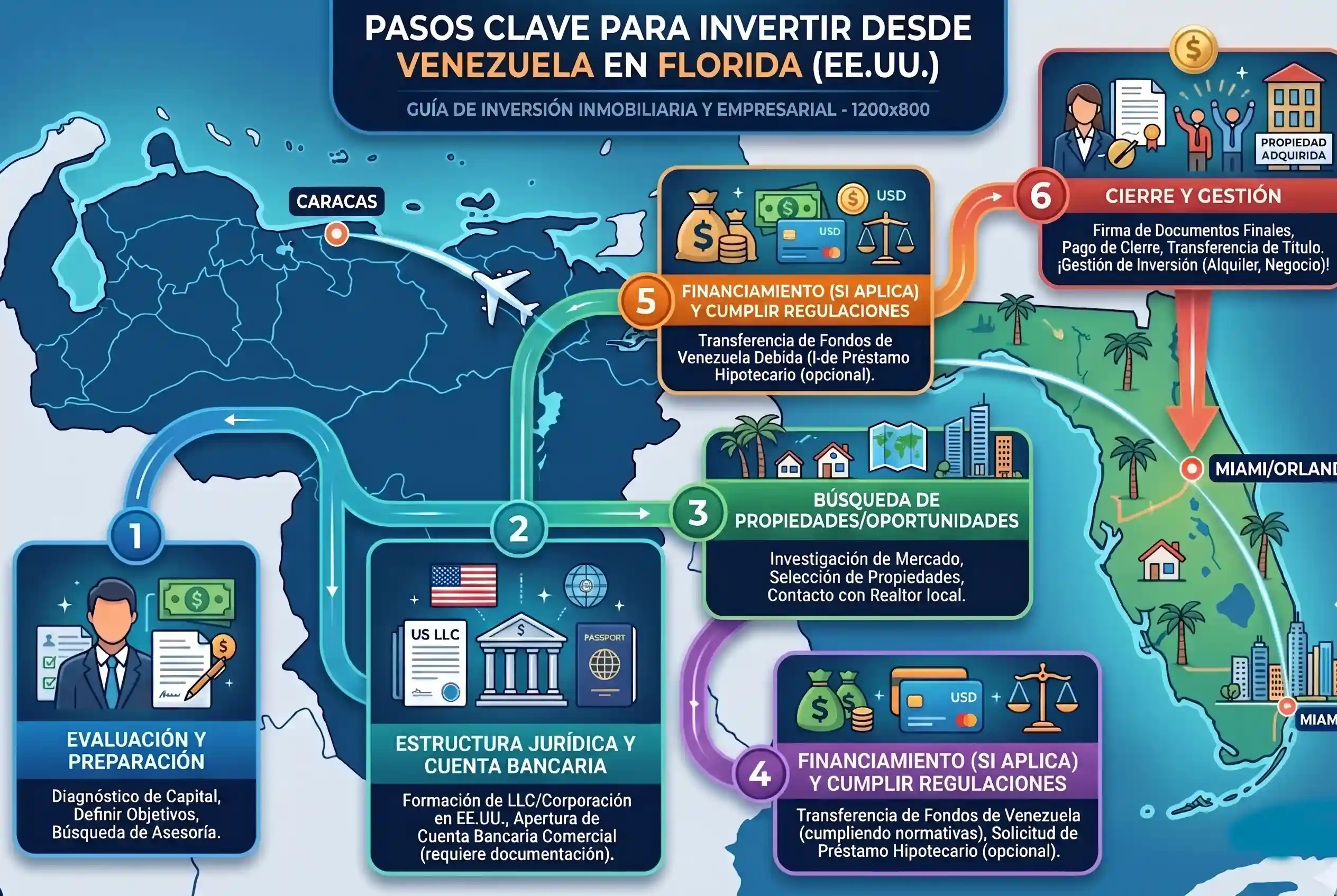
The purchase process from Mexico step by step
Step 1: Define your objective and budget Vacation rental or long-term rental? Orlando or Miami? Cash or with financing? These decisions determine the area, property type and process that follows.
Step 2: Mortgage pre-approval if financing Before searching for properties, get pre-approval from a lender with experience in foreign buyers. That defines your real budget and positions you as a serious buyer.
Step 3: Property search and selection With an agent who knows the market and understands the specific needs of a Mexican buyer operating from abroad. Visits can be done virtually with live video tours.
Step 4: Offer and escrow opening Once the offer is accepted, the escrow account opens and you deposit the earnest money (1% to 3% of the price). You have a due diligence period of 10 to 15 days for inspection and document review.
Step 5: Fund transfer Coordinate with your bank in Mexico and the title company in Florida to ensure funds arrive before the closing date. Plan with at least 10 business days of lead time.
Step 6: Remote closing Florida allows remote online notarization. You can sign all closing documents from Mexico with valid identification and a webcam. No travel required.
Step 7: Setup to generate income If your goal is rental income, coordinate furnishing, professional photography and platform listings before closing to start generating income as quickly as possible after delivery.
Tax considerations specific to Mexican buyers
As a foreign property owner in Florida, you have tax obligations worth understanding from the start.
Property tax in Florida is paid annually and ranges between 1% and 2% of the assessed value of the property. For a $350,000 property, that is between $3,500 and $7,000 per year.
Rental income generates an obligation to file federal tax returns with the IRS. As a foreigner, the IRS withholds a percentage of that income (generally 30%) unless you have an ITIN and file an annual return to claim applicable deductions.
When you sell, FIRPTA applies: the buyer withholds 15% of the sale price and delivers it to the IRS. If the actual tax is less than the withholding, you can request a refund. This is not an obstacle, but it requires planning.
You can see the full tax analysis in our guide on taxes when selling a property in Florida as a foreigner.
FAQ for Mexican investors in Florida
Do I need an American visa to buy a property in Florida?
No. Anyone can buy real estate in the United States without a visa or residency. What you do need to visit the property or attend the closing in person is a tourist visa or a valid visa to enter the country.
Can I use my Mexican RFC for tax obligations in the US?
No. In the United States you need an ITIN (Individual Taxpayer Identification Number) assigned by the IRS to file tax returns and manage withholdings. The ITIN is processed with the IRS and does not require physical presence in the US.
Does the Mexico-US tax treaty benefit me as an investor?
Mexico and the United States have a treaty to avoid double taxation that may benefit you depending on your tax situation. It is worth reviewing with an accountant who knows both tax systems before making decisions.
How long does the full process take from Mexico to having the property?
For a cash purchase of an existing property: between 30 and 45 days from when the offer is accepted to closing. With financing: between 45 and 60 days. The prior search can take weeks or months depending on how clearly you have defined your objective.
Buying in Florida from Mexico is a manageable process if you understand how the American system works and have the right team. The most common obstacles are not legal or financial: they are information gaps and poorly calibrated expectations from the start.