The question comes up in nearly every consultation with Latin American investors: do I buy the property in my name or put it in an LLC? And after explaining the LLC, the next question appears: what’s a revocable trust?
These are two distinct structures with distinct purposes. They’re not equivalent alternatives, and neither is categorically better than the other. Which one makes sense depends on which specific problem you’re trying to solve: asset protection, privacy, succession planning, or all three.
What each structure is and what it’s for
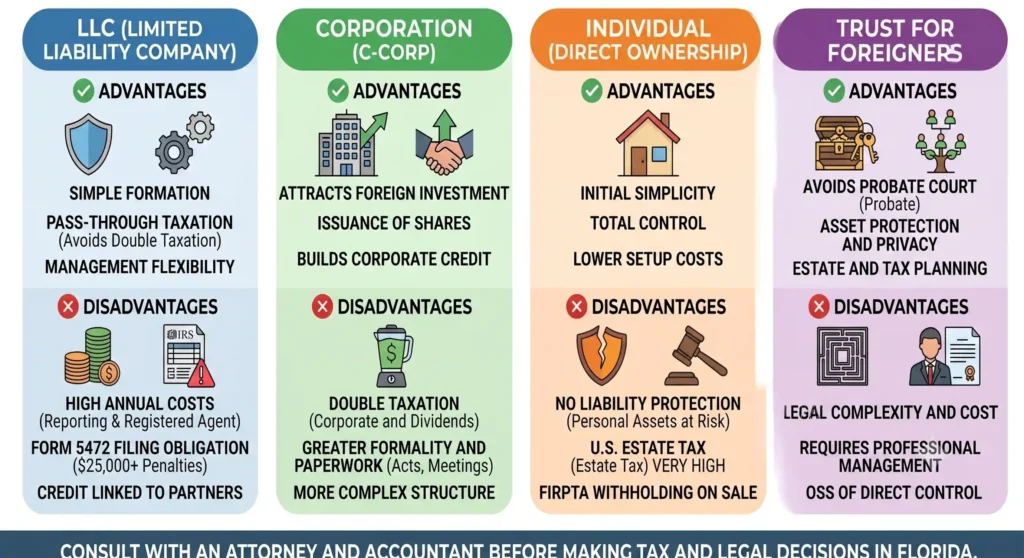
LLC (Limited Liability Company): A separate legal entity from its owner. When you buy a property through an LLC, legally the owner of the property is the company, not you. That creates a separation between your personal assets and the company’s assets.
Revocable Living Trust: A legal arrangement in which you transfer ownership of your assets to a trust, where you yourself act as trustee (administrator) and beneficiary during your lifetime. The trust is revocable because you can modify or cancel it at any time. Upon death, the trust’s assets pass directly to the beneficiaries you designated, without going through the American probate process.
The most important conceptual difference: the LLC protects your assets from external lawsuits while you’re alive. The revocable trust facilitates the transfer of those assets when you die.
Asset protection: the LLC wins clearly
If someone gets injured on your Florida property and sues you, what can they claim?
If the property is in your personal name, they can claim all your personal assets: other properties, bank accounts, investments. In the U.S., lawsuits for property accidents (slip and fall, pool accidents) are common and can result in significant amounts.
If the property is in an LLC, the claimant can only go after that specific LLC’s assets. Your personal assets are protected.
The revocable trust offers no asset protection. Because the trust is revocable and you control the assets, American courts consider those assets still accessible to your creditors. A creditor can “pierce” the trust and reach the assets.
For asset protection against lawsuits: LLC.
Succession: the revocable trust is superior
When a non-resident foreigner dies owning a property in Florida, that property must go through Florida’s probate process before it can be transferred to heirs.
American probate is a judicial process that can take between 6 months and 2 years, has legal fee costs of $3,000 to $15,000 or more depending on the asset value, and is public (anyone can view the probate documents).
Both the LLC and the revocable trust avoid American probate, but in different ways.
With an LLC: the property belongs to the company. If you die, your heirs inherit your participation in the LLC according to the operating agreement you defined. There’s no probate on the property itself, but there may be legal procedures around the transfer of LLC membership interest.
With a revocable trust: the trust’s assets pass automatically to the designated beneficiaries according to the trust’s terms. It’s the cleanest and most direct mechanism for transferring real estate assets.
For facilitating succession: revocable trust.
| Structure | Estate tax protection |
|---|---|
| Personal ownership | None (threshold $60,000) |
| American LLC | Partial (depends on structure) |
| Foreign LLC | Potentially better (requires advice) |
| Revocable trust | None additional |
| Irrevocable trust | High (if well structured) |
Estate tax: the risk most foreign investors ignore
This point is critical and little known.
For American citizens and residents, the estate tax applies to estates exceeding $13.6 million (2024 limit, subject to legislative changes). For non-resident foreigners, the exemption threshold is only $60,000. Everything above that $60,000 can be subject to a rate of up to 40%.
If you have a $500,000 property in Florida in your personal name and you die, the American estate tax could claim up to 40% of $440,000, which is $176,000. That’s before any inheritance tax in your home country.
A foreign LLC (incorporated outside the U.S.) that owns the property can, in certain structures, reduce this exposure. An irrevocable trust (different from revocable) can also be used for this purpose. This is an area where specialized legal advice makes enormous differences.
Privacy: both structures help, the LLC is simpler
In Florida, property records are public. If you buy a property in your personal name, anyone can search your name and see what properties you own.
With an LLC, the name in the registry is the company’s, not yours. Although the LLC owner’s name does have to be registered with the state of Florida (sunbiz.org), there’s an additional layer of privacy that reduces your direct exposure.
With a revocable trust, the trust’s name appears in the property registry (for example: “Juan García Revocable Trust”). It’s a layer of privacy, but the trustee’s name (generally the owner themselves) may appear in trust documents that are filed.
For greater privacy, some investors use an LLC whose sole member is the trust, combining the advantages of both structures.
Comparative costs
| Item | LLC | Revocable trust |
|---|---|---|
| Formation cost | $125–$300 (Florida) | $1,500–$3,500 (attorney fees) |
| Annual maintenance cost | $138 (Florida annual report) + honoraries | Generally none after formation |
| Requires attorney | Recommended | Mandatory |
| Formation timeline | 1–2 weeks | 2–4 weeks |
| Additional tax filing | Yes (depending on structure) | No (if single-grantor trust) |
The most common combination used by Latin American investors
In practice, the structure used by many Latin American investors with multiple properties or significant assets combines both tools.
One LLC per property (or per group of properties) for asset protection. A revocable trust that owns the LLC memberships to facilitate succession and avoid probate.
It’s more complex and has higher setup costs, but it simultaneously addresses asset protection, privacy, and succession planning.
For those starting with a first investment property, an LLC alone is sufficient in most cases. The revocable trust adds value as the portfolio grows and succession planning becomes more important.
Before deciding, it’s worth reviewing the implications of the inheritance tax in Florida for foreign property owners because that specific risk can completely change the recommended structure depending on the asset value and the investor’s country of residence.
Frequently asked questions
Can I change the structure after buying?
Yes. You can transfer a property from your personal name to an LLC or trust after purchase. The process is called a quitclaim deed and is relatively simple in Florida. But you need to verify with the bank if you have a mortgage, because some loans have acceleration clauses that are triggered if the title changes hands without the lender’s authorization.
Does the revocable trust pay taxes separately?
A single-grantor revocable trust doesn’t pay separate taxes. The trust’s income is reported on the grantor’s personal tax return. That significantly simplifies tax administration.
Do I need an American attorney to form a trust?
Yes. A poorly drafted trust may not meet its objectives (avoiding probate, protecting assets) or may have unintended tax consequences. This is one of the areas where an attorney’s fees are always justified.
Does the LLC need to have economic activity to maintain protection?
The LLC must maintain basic formalities: a separate bank account, not mixing personal and company funds, and renewing the annual report yearly. If those formalities aren’t maintained, a court can “pierce the corporate veil” and expose personal assets.
Is an LLC in another state (Delaware, Wyoming) better than one in Florida?
For properties in Florida, a Florida LLC is generally the simplest option. Delaware or Wyoming LLCs may have advantages in privacy or legal structure, but if the property is in Florida, you still have to register the foreign LLC in Florida as a foreign LLC, which adds procedures and costs.
The right structure depends on your specific situation: the asset value, your country of residence, whether you have children or heirs, and how many properties you plan to own.