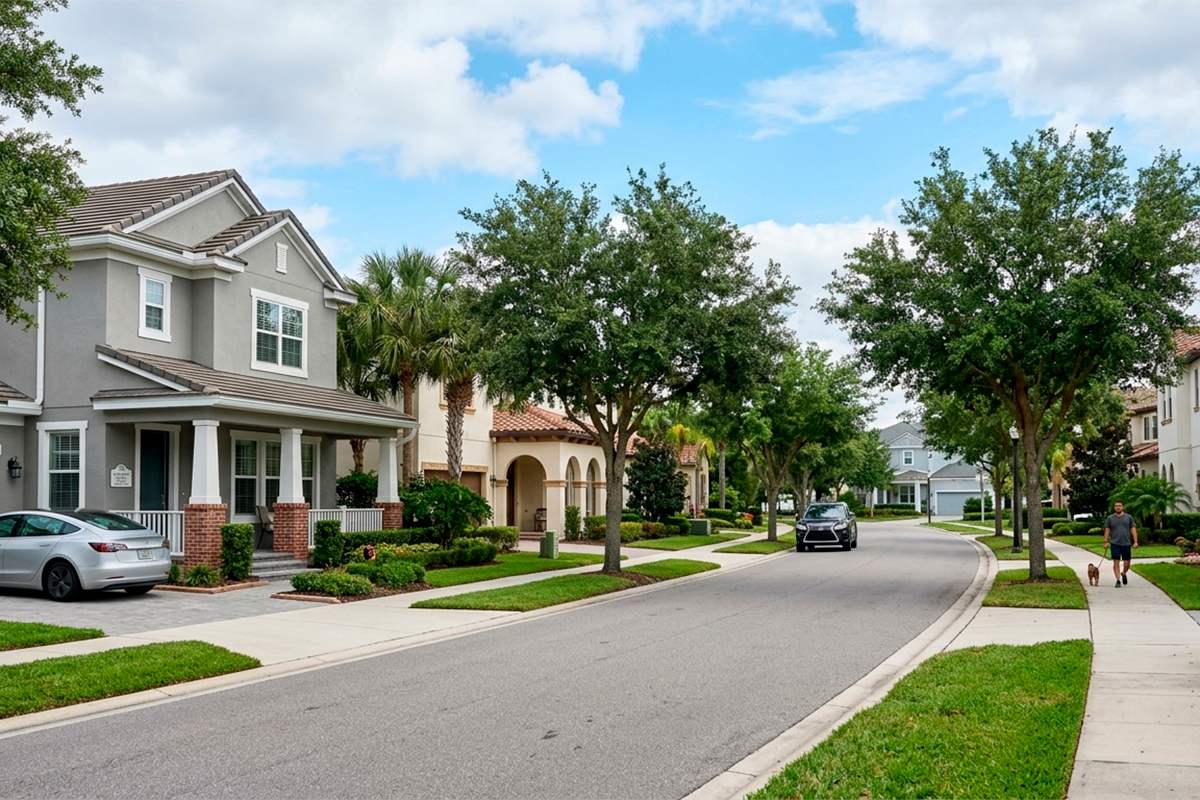
Airbnb accepts your property on the platform. That doesn’t mean the operation is legal in your municipality.
It’s the most expensive misunderstanding in the Orlando STR market. Airbnb does not verify local permits at the time of listing. That responsibility falls entirely on the owner. And the consequences of operating without the correct permits in the Orlando area range from $500 to $10,000 in fines per violation, with the possibility of being forced to pause operations while you get into compliance.
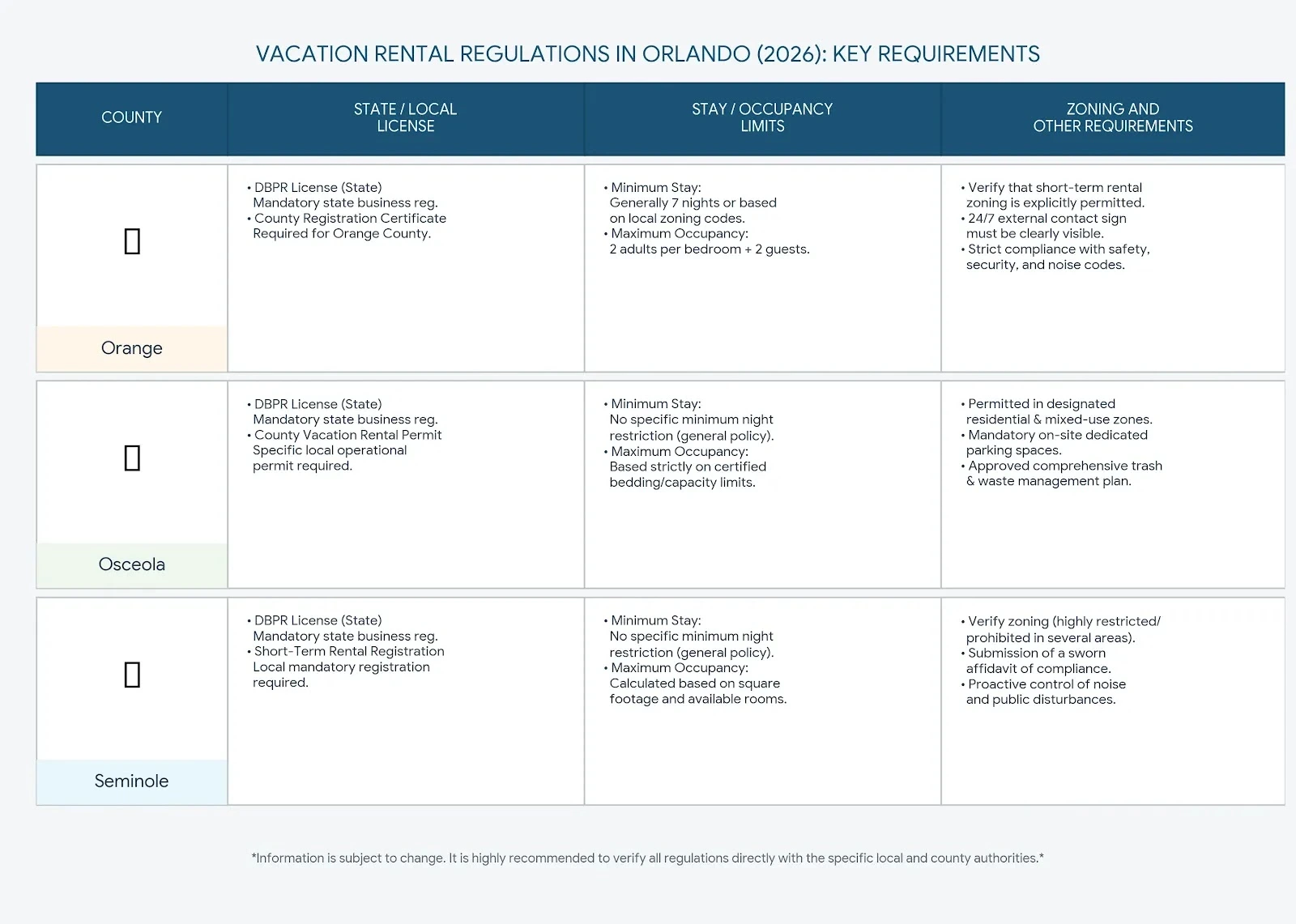
The Orlando metropolitan area covers three main counties (Orange, Osceola, and Seminole), each with its own rules, its own costs, and its own zones where short-term rental is permitted or restricted. What’s completely legal in Kissimmee can be prohibited three miles away in Orange County. That’s not an exaggeration; it’s the regulatory reality of this market.
This article covers the rules in effect in 2026 for each county. If your property is in the city of Orlando, Kissimmee, or any incorporated municipality within these counties, there’s an additional layer of municipal regulation on top of the county’s, and that is covered here too. And if you’re evaluating which zones make the most sense to buy in considering these restrictions, this guide on how to choose the best Orlando zone to invest in real estate helps you filter by regulatory viability from the initial analysis.
The state layer: what applies across all of Florida before reaching the county
Before the counties, there’s a state requirement that applies to every vacation rental property in Florida without exception.
The Florida DBPR (Department of Business and Professional Regulation) requires that any property rented for periods of less than 30 days more than three times a year obtain a vacation rental license. That license exists in two main formats:
- Vacation Rental Dwelling Unit: for single-family homes, townhouses, and individual condominiums
- Vacation Rental Condo: for condominiums within a complex with a collective license
The cost of the state license ranges from $150 to $300 depending on the property type and whether it’s a renewal or new application. It renews annually. Without this license, any listing on Airbnb, VRBO, or any other platform is technically illegal under state law, regardless of what the county says.
That’s the base. County regulations build on top of it.
Orange County: the most restrictive in the area
Orange County has the most complex STR regulation in the Orlando metro, primarily because it combines county rules with those of the city of Orlando and several incorporated cities within its territory.
In the county’s unincorporated zones (areas outside any city with its own government), STR of less than 30 days is generally prohibited in residential zones without a Special Use Permit. That permit exists, but it’s a discretionary approval process requiring a public hearing and it’s not guaranteed. In practice, most residential properties in Orange County’s unincorporated zones can’t legally operate as short-term rentals.
In the city of Orlando the rules are different and more nuanced. The city has a vacation rental registration system with specific zones where it’s permitted. The municipal registration costs between $250 and $500 annually and requires the property to pass a habitability inspection. There are density restrictions: you can’t have too many vacation rentals within a certain radius, plus restrictions on noise, parking, and number of occupants.
Lake Buena Vista and the Disney corridor have their own dynamic. Properties in complexes specifically designed for vacation rental (Windsor Hills, Encore Resort, and Reunion Resort) have approvals built into the development’s land use. These are the clearest cases: the complex was designed for it, has resort zoning, and STR is explicitly permitted.
| Zone in Orange County | STR permitted | Main requirements | Approx. annual cost |
|---|---|---|---|
| Unincorporated residential zones | No, except with Special Use Permit | Discretionary approval process | N/A |
| City of Orlando (approved zones) | Yes with registration | Municipal registration + inspection + DBPR | $400–$800 |
| Resort complexes (Windsor Hills, Encore, etc.) | Yes | State DBPR + Tourist Tax | $150–$350 |
| Incorporated areas (Windermere, Edgewood) | Varies by municipality | Verify local ordinance | Variable |
Penalties in Orange County run from $500 for a first violation to $5,000 for repeated violations. The city of Orlando can add $1,000–$10,000 in administrative fines plus registration suspension. Enforcement is triggered primarily by neighbor complaints. In residential zones where STR is not permitted, neighbors do complain.
Osceola County: the most permissive for STR
Osceola County is where the Orlando STR market really lives. Kissimmee, Celebration, Four Corners, the US-192 corridor. These zones were historically built around tourism and the regulations reflect that.
The county permits STR in tourist and mixed-use zones without the restrictive land-use rules that exist in Orange County. The Florida DBPR vacation rental license is the primary requirement, supplemented by county registration and the Tourist Development Tax.
Kissimmee, the incorporated city within Osceola, has its own registration system but is generally permissive with vacation rentals in commercial and mixed-use zones. Pure residential areas of Kissimmee have more restrictions, but the near-Disney property stock is mostly in zones where STR is viable.
The resort complexes in Osceola are the main destination for short-term rental in the area: ChampionsGate, Solterra, Paradiso Grande, Regal Oaks, Windsor at Westside, among others. These developments have resort zoning specifically for vacation rental and account for the majority of the region’s STR inventory. For details on which of these complexes perform best in terms of occupancy and net return, this guide to the best Kissimmee neighborhoods for successful short-term rentals compares the main corridors with current market data.
| Zone in Osceola County | STR permitted | Main requirements | Approx. annual cost |
|---|---|---|---|
| Resort complexes (Solterra, ChampionsGate, etc.) | Yes | DBPR + county registration + Tourist Tax | $250–$500 |
| Kissimmee tourist and mixed-use zones | Yes with registration | DBPR + city registration + Tourist Tax | $300–$600 |
| Kissimmee residential zones | Restricted | Verify specific zoning | Variable |
| Celebration | Significant HOA restrictions | HOA can prohibit independently of county | Variable |
Penalties in Osceola County run $250–$2,500 per violation depending on severity and repeat offenses, significantly lower than Orange County, reflecting the county’s historically more permissive culture toward tourism.
One note on Celebration: although it’s in Osceola County, the Celebration HOA has its own restrictions on short-term rental that in many cases are more restrictive than the county’s rules. The HOA can prohibit STR independently of what the county permits. In Celebration, many owners have discovered that only after buying.
Seminole County: residential first, tourism second
Seminole County, which includes Sanford, Altamonte Springs, Casselberry, and Winter Springs, is fundamentally a residential county. Tourism is not the economic driver here, and STR regulations reflect that.
The county requires DBPR registration and licensing, but zoning restrictions in residential areas are more similar to Orange County than to Osceola. Most residential neighborhoods in Seminole are not designed or zoned for high-turnover STR, and enforcement through neighbor complaints is active.
Sanford has some historic and commercial zones where STR works, but the volume is small compared to the Disney corridor. Lake Mary and Heathrow are essentially residential. Operating STR there without the correct permits is a real risk.
| Zone in Seminole County | STR permitted | Main requirements | Approx. annual cost |
|---|---|---|---|
| Standard residential zones | Restricted: verify zoning | DBPR + county registration if applicable | Variable |
| Sanford historic/commercial zones | Yes in some areas | DBPR + city registration | $200–$450 |
| Altamonte Springs residential | Generally no | Restrictive residential zoning | N/A |
| Condominiums and mixed complexes | Varies by property | HOA + DBPR + verify zoning | Variable |
The Tourist Development Tax: the registration everyone forgets
Every county in the Orlando metro charges a Tourist Development Tax (TDT) on short-term rentals. This is separate from the DBPR license and county registration. It is a tax on gross rental revenue that applies to every booking regardless of which platform it comes from.
| County | TDT rate 2026 | Who remits |
|---|---|---|
| Orange County | 6% on gross rent | Airbnb/VRBO remit automatically |
| Osceola County | 6.5% on gross rent | Platform or owner |
| Seminole County | 5% on gross rent | Platform or owner |
For bookings made through Airbnb or VRBO, these platforms remit the TDT automatically in most Orlando area counties. For direct bookings outside the platforms, the obligation to collect and remit the tax is yours. If you do any volume of direct bookings and aren’t registered with the county Tax Collector, you’re accumulating a tax liability.
Checklist before activating your STR in Orlando
- Verify the specific zoning of your parcel on the county portal
- Verify HOA rules, as they can be more restrictive than local government
- Obtain the Florida DBPR vacation rental license
- Register for the Tourist Development Tax with the county Tax Collector
- Obtain municipal permit if your city requires one (Orlando, Kissimmee)
- Verify safety requirements: smoke detectors, fire extinguisher, pool barriers if applicable
- Publish your listing with your license number visible
Frequently asked questions
Do I need a license to operate Airbnb in Orlando?
Yes, in all cases. You need at least the Florida DBPR state vacation rental license. Depending on where the property is, you also need county registration and possibly an additional municipal permit. Airbnb accepts properties without verifying local permits. The responsibility for having everything in order is the owner’s, not the platform’s.
Can I do Airbnb in Orange County residential zones?
In the unincorporated zones of Orange County, generally no. STR of less than 30 days is restricted in residential zones except with a Special Use Permit, which requires a public hearing and isn’t guaranteed. In the city of Orlando, it depends on the specific zoning of the address. Before buying a property in Orange County for STR, verify the exact zoning of that parcel on the county portal and confirm whether the city has vacation rental registration available in that zone.
How much do permits cost in total?
It depends on the county and city. The total (Florida DBPR plus county registration plus municipal permit if applicable) runs from $350 to $800 annually in most cases in the Orlando area. In Osceola resort complexes without an additional municipal layer, it can sit at the low end. In the city of Orlando with all layers included, at the high end.
What happens if I operate without permits?
Fines range from $250 in Osceola County to $10,000 in the city of Orlando for repeated violations. Beyond the financial cost, operating without permits can result in being required to pause operations, affecting income while you get into compliance. Enforcement runs primarily through neighbor complaints. In residential zones where STR is not welcome, that risk is real and ongoing.
Is Osceola County more permissive than the others?
For properties in resort complexes and tourist zones, yes, significantly. The near-Disney corridor in Osceola was zoned for tourism and vacation rental, and the regulations reflect that. But that doesn’t apply to all of Osceola. Residential areas of Kissimmee have restrictions similar to Orange County, and Celebration has additional HOA restrictions that can be more limiting than the county’s own rules.
Do platforms remit the Tourist Development Tax automatically?
For bookings made through the platform, Airbnb and VRBO remit the TDT automatically in most Orlando area counties. For direct bookings outside the platforms, the obligation to collect and remit the tax is yours. If you do any volume of direct bookings and aren’t registered with the county Tax Collector, you’re accumulating a tax liability that compounds over time.
If you have a property in Orlando or are evaluating a purchase for STR, contact the Florida HomeGroup Realty team for advice based on your specific property address and investment profile.